| - | - | - |
|---|---|---|
| Product Group | : | Antiparasitics |
| Pharmaceutical Form | : | Solution for Injection |
| Active Ingredient | : | Ivermectin, Clorsulon |
| Target Animal | : | Cattle |
| Package Form | : | 50 ml and 100 ml Colorless Glass Flacons |
COMPOSITION
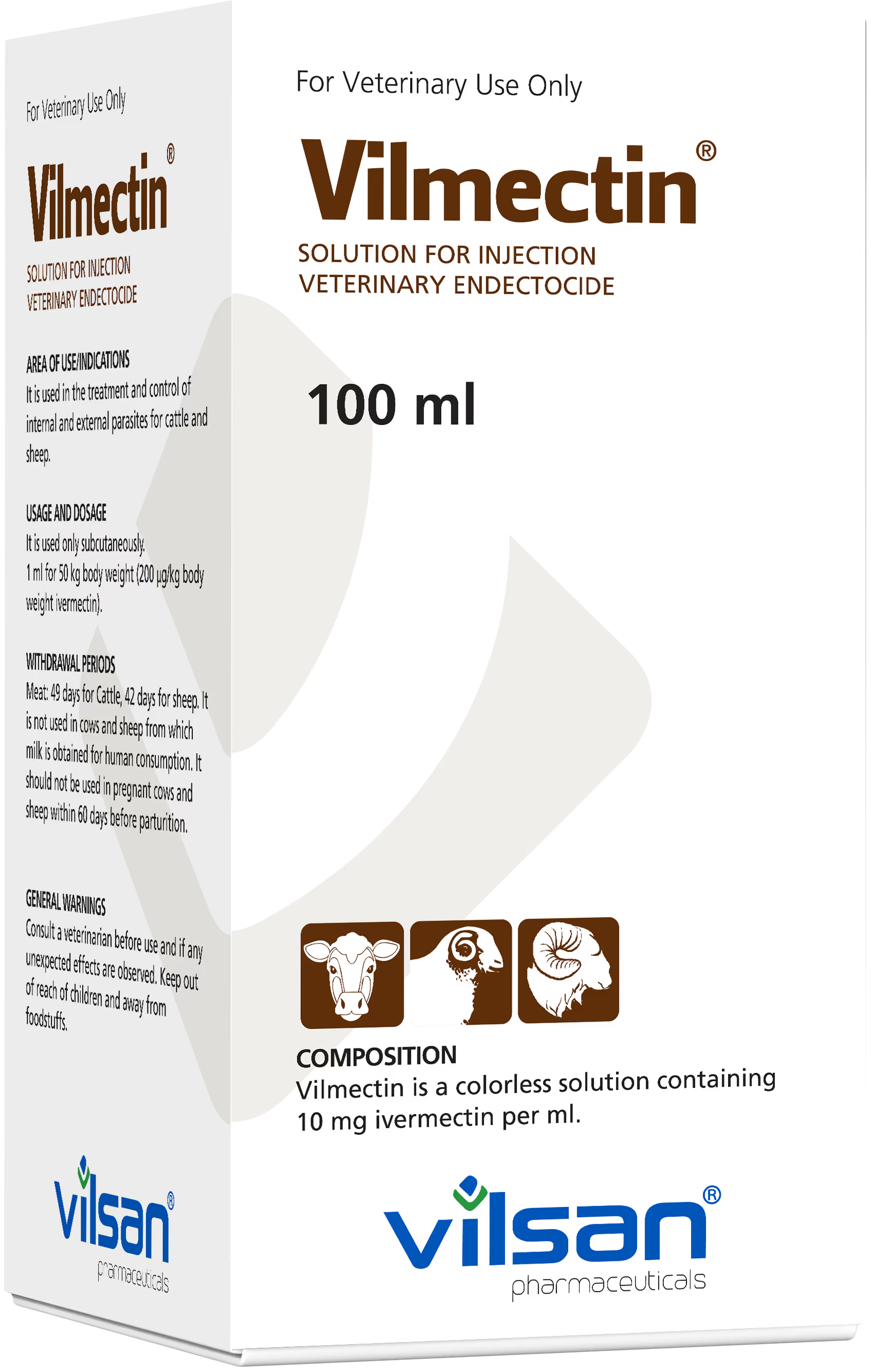
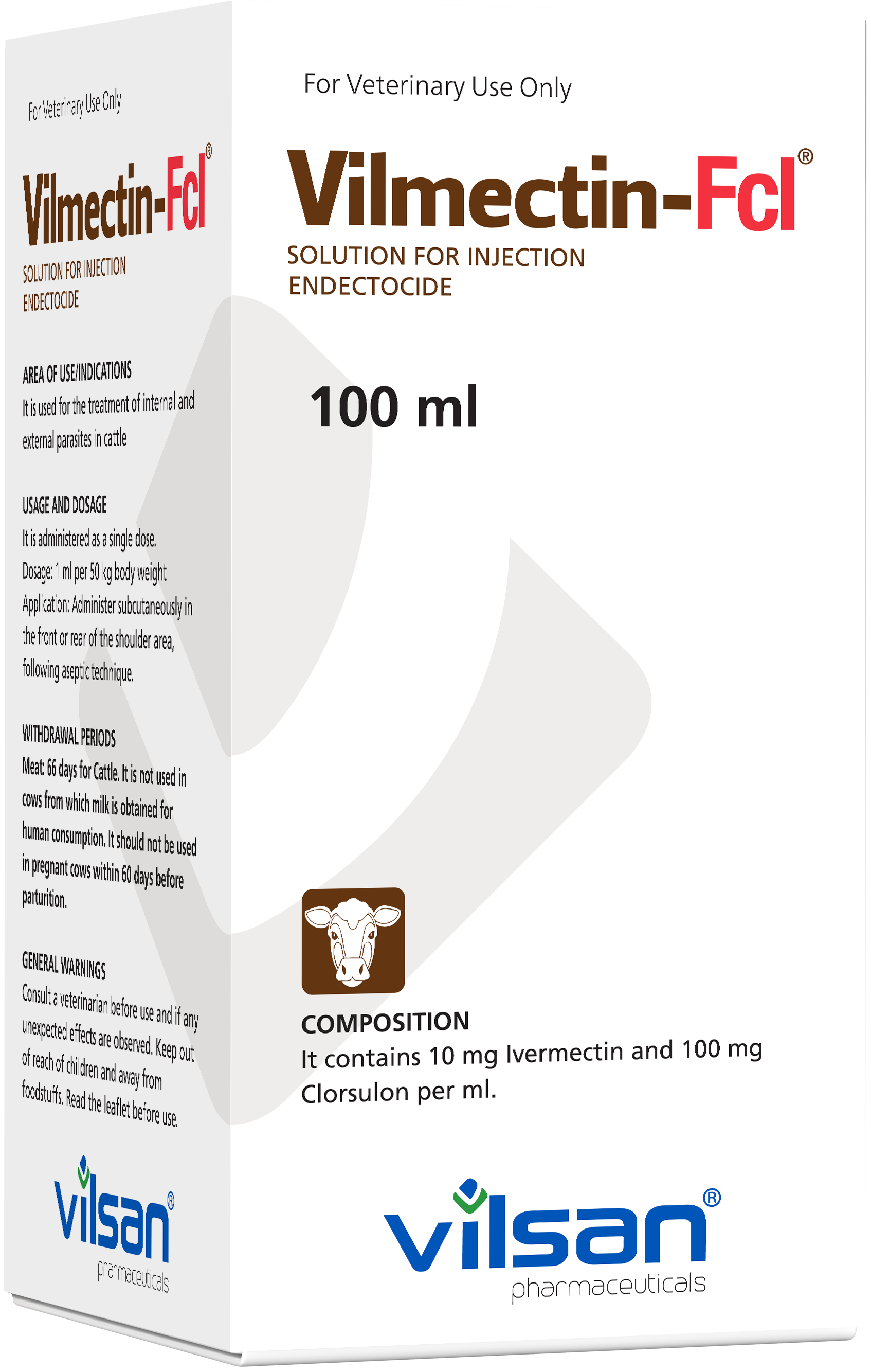
Vilmectin FCL is a colorless or pale yellow colored solution containing 10 mg ivermectin and 100 mg clorsulon per ml.
PHARMACOLOGICAL PROPERTIES
Pharmacodynamic properties
Ivermectin is a macrocyclic lactone derivative and exerts its effect by inhibiting nerve transmissions. It binds with high selectivity to glutamate-gated chloride ion channels in parasites. As a result, the permeability of cell membranes to chloride ions increases, causing hyperpolarization in nerve or muscle cells, leading to paralysis and ultimately death. Compounds in this class interact with ligand-gated chloride channels through neurotransmitter transport channels such as GABA. In mammals, its safety is due to the absence of glutamate-gated chloride channels in mammalian cells. Macrocyclic lactones have a low affinity for ligand-gated chloride channels in mammals and cannot easily cross the blood-brain barrier.
Clorsulon is a sulfonamide. It rapidly enters the bloodstream. In adult Fasciola hepatica, it exerts its lethal effect by inhibiting enzymes involved in the glycolytic pathway, which is the primary energy source.
Pharmacokinetics Properties
After subcutaneous administration at the therapeutic dose, ivermectin reaches its plasma peak concentration (Cmax: 65.80 ng/ml) in 1-2 days, while clorsulon (Cmax: 2.58 μg/ml) reaches its peak concentration about 8 hours later. The half-lives of ivermectin and clorsulon are approximately 3.79 days and 3.58 days, respectively.
Only 2% of ivermectin is excreted in urine; the main excretion route is feces. After administration, the highest concentrations are found in the liver and adipose tissue, with the lowest concentration in the brain.
The residual antiparasitic effect in cattle is due to its long half-life and 90% binding to proteins.
AREA OF USE/INDICATIONS
It is used in the treatment of the following internal and external parasites in cattle:
-Gastrointestinal nematodes:
-Ostertagia ostertagi (adult; L3 larvae; L4 larvae, including hypobiosis)
-Ostertagia lyrata (adult and L4 larvae)
-Haemonchus placei (adult; L3 and L4 larvae)
-Mecistocirrus digitatus (adult)
-Trichostrongylus spp. (adult, L4 larvae)
-Cooperia spp. (adult, L3 and L4 larvae)
-Oesophagostomum radiatum (adult; L3 and L4 larvae)
-Nematodirus spp. (adult)
-Bunostomum phlebotomum (adult; L3 and L4 larvae)
-Strongyloides papillosus (adult)
-Trichuris spp. (adult)
-Toxocara vitulorum (adult, L3 and L4 larvae)
-Lung nematodes (adult and 4th stage larvae):
Dictyocaulus viviparus
-Subcutaneous nematodes:
Parafilaria bovicola (adult)
-Eye nematodes:
Thelazia spp. (adult)
-Larval stage pathogens:
Hypoderma bovis
H. lineatum
Dermatobia hominis
Chrysomya bezziana
-Mange:
Psoroptes ovis
Sarcoptes scabiei var. bovis
-Lice:
Linognathus vituli
Haematopinus eurysternus
Solenopotes capillatus
-Ticks:
Ornithodorus savignyi
Boophilus microplus
-Liver fluke:
Fasciola hepatica (adult)
Fasciola gigantica (adult)
Ivermectin can be used to control Damalinia bovis and Chorioptes bovis, but complete elimination may not be possible.
The recommended dosage of this product can prevent re-infection for the following periods:
Haemonchus placei, Cooperia oncophora, Cooperia pectinata, and Trichostrongylus axei for 14 days
Ostertagia ostertagi and Oesophagostomum radiatum for 21 days
Dictyocaulus viviparus for 28 days
The timing of the treatment may vary depending on epidemiological factors and the characteristics of the farm. The treatment schedule should be assessed by the veterinarian.
USAGE AND DOSAGE
It is administered as a single dose.
For accurate dosage, the animals' body weight should be measured correctly whenever possible. The accuracy of the dosing device should be checked.
If mass treatment is to be applied, animals should be properly grouped to avoid excessive or insufficient dosage.
Application to wet or dirty animals is not recommended.
Dosage: 1 ml per 50 kg body weight (200 micrograms of ivermectin and 2 mg of clorsulon per kg of body weight)
Application: Administer subcutaneously in the front or rear of the shoulder area, following aseptic technique. A sterile 1.4 x 15 mm (17G x ½ inch) needle is recommended. Doses greater than 10 ml should be divided.
At temperatures below 5 ºC, the increased viscosity may make the product difficult to apply. This issue can be resolved by warming the product to approximately 15 ºC. If used with other injectable products, different injection sites should be chosen.
SPECIAL CLINICAL INFORMATION AND SPECIAL WARNINGS FOR TARGET SPECIES
Due to the risk of resistance development and consequently treatment failure, the following practices should be avoided:
- Frequent and repeated use of the same group of anthelmintics within a short period of time.
- Incorrect calculation of body weight, incorrect administration of the product, or using a miscalibrated dosing device, which can lead to administering less than the required dose.
In cases where resistance to anthelmintics is suspected, appropriate tests should be conducted (e.g., fecal egg count reduction test (FECRT)). If data show that resistance to a specific anthelmintic has developed, another product with a different pharmacological class and mode of action should be used.
Resistance to macrocyclic lactones, including ivermectin, has been reported in sheep to Teladorsagia, in lambs to Ostertagia circumcinta, and in cattle to Ostertagia ostertagi and Cooperia. Therefore, this product should be used according to regional (farm-level or broader) epidemiological susceptibility data.
Avermectins may not be well tolerated in non-target species. Intolerance events leading to death have been reported in dogs, particularly Collies, Bobtails, Old English Sheepdogs, and closely related or cross-bred breeds, as well as in turtles.
Do not combine with lungworm vaccines. If the product is to be applied to vaccinated animals, it should be administered 28 days before or after vaccination.
The excretion of nematode eggs may continue for some time after treatment.
In cattle, to avoid secondary reactions caused by the death of Hypoderma larvae in the esophagus and spine, the product is recommended to be applied at the final stage of the fly larvae, before they reach these areas. The death of Hypoderma lineatum in the peri-esophageal tissue may cause salivation and tympany. The death of Hypoderma bovis in the spinal canal may lead to paresis or paralysis.
Clean the bottle before each use.
Use during pregnancy: This product can be used in pregnant cattle and sheep. For detailed information regarding its use during lactation, refer to the “Contraindications” and “Residue Warnings in Food-Producing Animals” sections. The product has no negative effect on fertility.
ADVERSE EFFECTS
In some animals, discomfort may occur after subcutaneous administration. In cattle, this manifests as jumping and rolling. These behaviors typically return to normal within 15 minutes after administration. Hardening and swelling may be observed at the injection site. These reactions are temporary and will disappear within 1-4 weeks.
DRUG INTERACTIONS
Do not combine with lungworm vaccines. If the product is to be applied to vaccinated animals, it should be administered 28 days before or after vaccination.
Do not mix with other medicinal products
SYMPTOMS OF OVERDOSE, PRECAUTIONS AND ANTIDOTE
The clinical symptoms of ivermectin toxicity are ataxia and depression (when administered at 20 times the recommended dose). There is no antidote. In case of overdose, symptomatic treatment should be applied. When administered at 25 times the recommended dose, lesions (necrosis, edema, fibrosis, and inflammation) have been observed at the injection site
WITHDRAWAL PERIODS
Meat: 66 days for Cattle. It is not used in cows from which milk is obtained for human consumption. It should not be used in pregnant cows within 60 days before parturition.
CONTRAINDICATIONS
It is not administered intravenously or intramuscularly. This product is intended for use in cattle only. Due to potential serious side effects, it is not used in other species, especially in cats and dogs. It should not be used in animals known to be sensitive to its components.
GENERAL WARNINGS
The product is highly toxic to aquatic organisms and manure insects. Cattle should not have direct access to ponds, streams, or ditches within 14 days after treatment. Due to continuous or repeated use, the long-term effects on manure insects should not be overlooked. Therefore, repeated treatments in a pasture during one grazing season should only be done on the advice of a veterinarian.
Consult a veterinarian before use and if any unexpected effects are observed. Keep out of reach of children and away from foodstuffs.
PRECAUTIONS TO BE TAKEN BY THE ADMINISTRATOR AND WARNINGS FOR VETERINARY SURGEON
Do not consume anything, including cigarettes, during the application of the product. Wash your hands after use. Since it may cause irritation and pain at the injection site, take necessary precautions to prevent accidental injection. In case of accidental self-injection, consult a doctor with the product label and leaflet. Avoid contact with the product. If contact occurs, wash the area thoroughly with water and soap. In case of eye contact, rinse the eye with plenty of running water.
STORAGE CONDITIONS AND SHELF LIFE
Before and after opening, the product should be stored in the original packages, protected from light, below 25°C, without refrigeration or freezing. The shelf life is 3 years. After opening, it should be used within 28 days.
DISPOSAL AFTER USE AND WARNINGS FOR NON-TARGET SPECIES
IT IS HIGHLY TOXIC TO FISH AND AQUATIC LIFE. The product or used product containers must not be disposed of in water sources or areas near these sources.
COMMERCIAL PRESENTATION FORM
It is presented in 50 ml and 100 ml colorless type II vials, stoppers and flip-off caps, with cardboard box.
PLACE AND CONDITIONS OF SALE
It is sold in pharmacies and veterinary clinics with a veterinarian's prescription. (VHP)
APPROVAL DATE OF LEAFLET: 06.03.2024
MARKETING AUTHORIZATION DATE AND NO: 06.09.2001 – 10/967
NAME AND ADDRESS OF MARKETING AUTHORIZATION HOLDER
VİLSAN Veteriner İlaçları Tic. ve San. A.Ş.
Balıkhisar Mah. Balıkhisar Köy içi Küme Evleri No: 765A Akyurt/Ankara – Türkiye
MANUFACTURER COMPANY
VİLSAN Veteriner İlaçları Tic. ve San. A.Ş.
Balıkhisar Mah. Balıkhisar Köy içi Küme Evleri No: 765A Akyurt/Ankara – Türkiye
Made in Turkiye