| - | - | - |
|---|---|---|
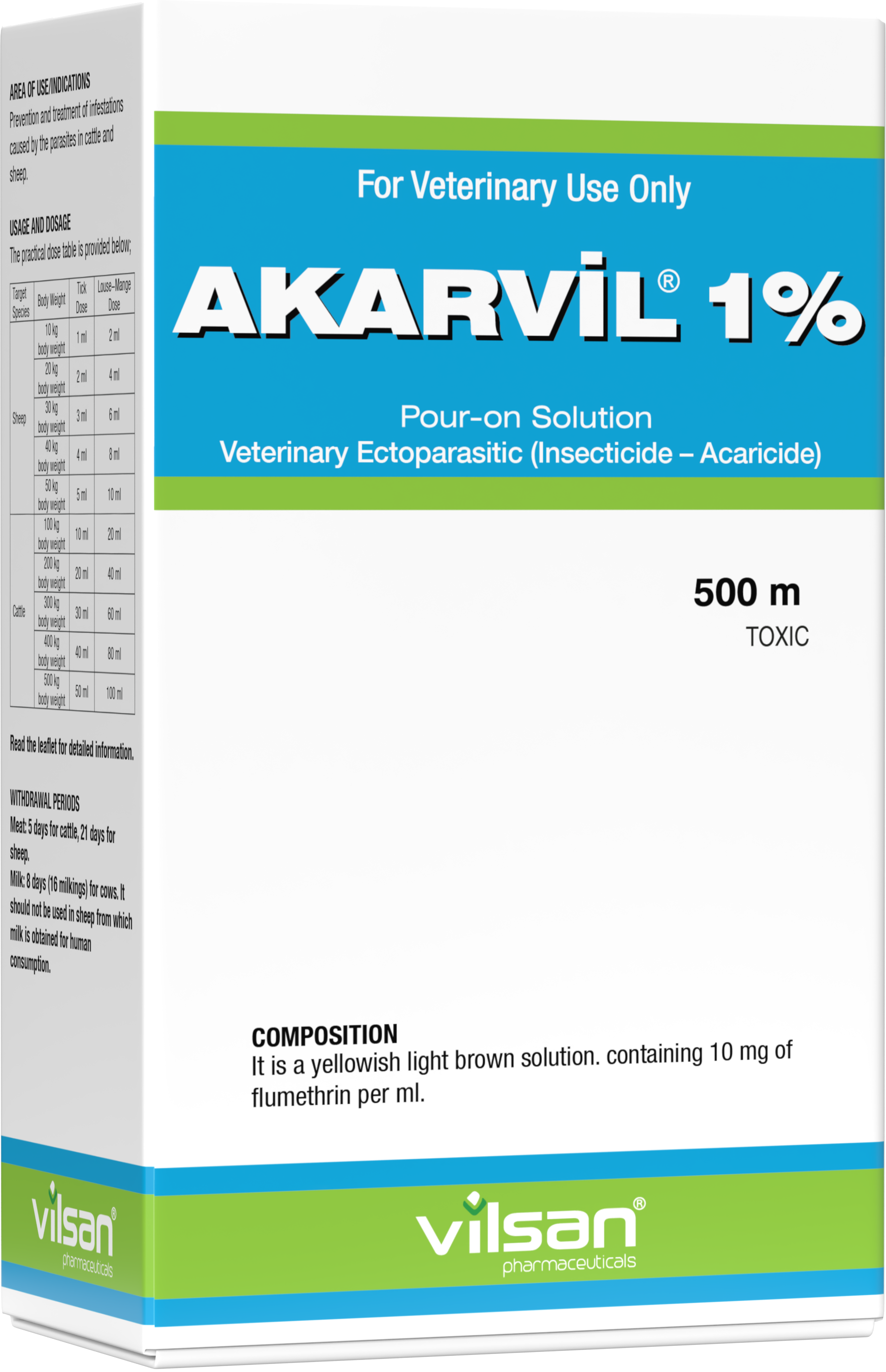
| Product Group | : | Antiparasitics |
| Pharmaceutical Form | : | Pour-On Solution |
| Active Ingredient | : | Flumethrin |
| Target Animal | : | Cattle, Sheep |
| Package Form | : | In polyamide alloy coex bottles with 100 ml and 500 ml scales |
COMPOSITION
It is a yellowish light brown solution. containing 10 mg of flumethrin per ml.
PHARMACOLOGICAL PROPERTIES
Pharmacodynamic Properties
Flumethrin is a type II synthetic pyrethroid, derived from pyrethrins obtained from certain plants, like other members of this group. Pyrethroids have repellent effects as well as contact insecticidal and acaricidal effects. The site of action is voltage-gated sodium channels found in nerve cells.
Flumethrin causes these channels to remain open for an extended period of time. In arthropods, this initially causes stimulation and coordination disorders, followed by paralysis and death after a sufficient period of time. It also inhibits egg production in female ticks and reduces the rate of live larvae formation from eggs.
The acute toxicity of flumethrin varies depending on the solvent used. The oral LD50 value for rats is 41-3849 mg/kg body weight.
The acute toxicity of flumethrin varies depending on the solvent used. The oral LD50 value for rats is 41–3849 mg/kg body weight.
In chronic toxicity studies, the NOEL value for rats was found to be 0.7-0.8 mg/kg body weight (daily-oral) and the NOEL value for dogs was found to be 0.88 mg/kg body weight (daily-oral).
It is well tolerated in cattle when applied topically.
In reproductive toxicity studies conducted on rats and rabbits, the NOEL values for maternal toxicity were 0.5 mg/kg and 1.7 mg/kg body weight per day, respectively, and the NOEL values for fetal toxicity were 1.0 and 1.7 mg/kg body weight per day, respectively.
Flumethrin is classified as a non-genotoxic and non-carcinogenic substance.
Pharmacokinetic Properties
After application to the skin, it is rapidly absorbed from the surface and distributed to other parts of the body within 1-4 hours. Plasma and milk levels are very low. Accumulation in tissues is low except in the application area.
Approximately 70% of the applied dose remains in the application site, while 30% is absorbed by the skin. It is metabolized via ester hydrolysis and excreted through the urinary and biliary systems.
Environmental Properties
Due to its dangerous effect on fish and other aquatic organisms, the product, finished product packaging, or materials that have come into contact with the product should not be disposed of in water sources. Flumethrin is also toxic to bees.
AREA OF USE/INDICATIONS
Prevention and treatment of infestations caused by the following parasites
Cattle:
- Ticks (Ixodes, Amblyomma spp., Dermacentor, Boophilus spp., Hyalomma spp, Haemaphysalis, and Rhipicephalus)
- Lice (Linognathus vituli, Haematopinus eurysternus, Bovicola bovis)
- Mange (Chorioptes bovis, Sarcoptes bovis, Psoroptes ovis)
Sheep:
Louse and tick infestations
USAGE AND DOSAGE
The product is ready for use and should be shaken before use. The product is applied in a line along the spine of the animal, starting from the shoulder to the tail. Due to the abundance of wool in sheep, the wool should be separated by hand to reveal the spine line before application.
Rain has no negative effect on the initial effectiveness of the product, but it may shorten its effectiveness after application.
The application dose for tick control in cattle and sheep is 1 mg/kg body weight, and for mange and lice control, it is 2 mg/kg body weight. The practical dose table is provided below;
|
Target Species |
Body Weight |
Tick Dose |
Louse-Mange Dose |
|
Sheep |
10 kg body weight |
1 ml |
2 ml |
|
20 kg body weight |
2 ml |
4 ml |
|
|
30 kg body weight |
3 ml |
6 ml |
|
|
40 kg body weight |
4 ml |
8 ml |
|
|
50 kg body weight |
5 ml |
10 ml |
|
|
Cattle |
100 kg body weight |
10 ml |
20 ml |
|
200 kg body weight |
20 ml |
40 ml |
|
|
300 kg body weight |
30 ml |
60 ml |
|
|
400 kg body weight |
40 ml |
80 ml |
|
|
500 kg body weight |
50 ml |
100 ml |
The product should be applied to all animals that come into contact with each other or are likely to do so. One application is usually sufficient for treatment. In cases of severe mange infestation, treatment should be repeated after two weeks.
The duration of effectiveness against ticks is approximately three weeks.
SPECIAL CLINICAL INFORMATION AND SPECIAL WARNINGS FOR TARGET SPECIES
As with other antiparasitic products, frequent and repeated use of products belonging to the same class may lead to the development of resistance.
This product is not intended for use as a preventive measure against infestation.
This product should be considered a reserve treatment, to be used in cases of coccidiosis outbreaks when vaccines are unavailable, ineffective, or when serious coccidial threats are diagnosed in vaccinated flocks before full immunity has developed.
Treatment should only be carried out in the barn/pen. Animals that have been treated with medication should not be released into the pasture for at least 12 hours.
Use during pregnancy: No teratogenic or embryotoxic effects have been observed in laboratory studies conducted on rats and rabbits. It can be used during pregnancy and lactation. However, it should not be administered to sheep used for human consumption.
ADVERSE EFFECTS
Like other pyrethroids, it may rarely cause anxiety/agitation in animals, and very rarely, temporary diarrhea may occur.
DRUG INTERACTIONS
Organic phosphorus compounds increase the toxicity of pyrethroids. Therefore, they should not be used in combination with this group of drugs.
Do not use in combination with other external ectoparasitic products.
SYMPTOMS OF OVERDOSE, PRECAUTIONS AND ANTIDOTE
In cattle, doses up to 10 mg/kg are well tolerated. However, the recommended dose should not be exceeded.
Doses above 20 mg/kg cause skin irritation. Temporary redness and temporary diarrhea may occur in some animals. Like other pyrethroids, excessive doses may trigger behaviors such as tail wagging and licking of the rump area. If the animal ingests the product, contact a veterinarian immediately. There is no specific antidote. Symptomatic treatment should be administered in cases of poisoning.
WITHDRAWAL PERIODS
Meat: 5 days for cattle, 21 days for sheep.
Milk: 8 days (16 milkings) for cows. It should not be used in sheep from which milk is obtained for human consumption.
CONTRAINDICATIONS
Not to be used on animals sensitive to the ingredients in the product.
GENERAL WARNINGS
Consult a veterinarian before use and if any unexpected reactions occur.
Keep out of reach of children and away from foodstuffs.
PRECAUTIONS TO BE TAKEN BY THE ADMINISTRATOR AND WARNINGS FOR VETERINARY SURGEON
This product may cause hypersensitivity and irritation to the eyes or skin in humans. During application, avoid direct eye or skin contact with the product, animals that have been treated with the product, or application equipment.
Users should wear waterproof nitrile gloves and boots when applying the product.
Users should wear waterproof nitrile gloves and boots during application.
The protective equipment used should be thoroughly washed after use. After use, hands and face should be washed with soap and water.
In case of accidental contact with skin or mucous membranes, immediately wash the affected area with soap and water. If the product comes into contact with the eyes, rinse thoroughly with water and seek medical advice.
Do not eat, drink, or use tobacco products during application.
This product is for external use on animals only and should not be ingested by humans or animals.
Keep away from food and beverages.
If accidentally ingested, induce vomiting and seek medical attention immediately.
Paresthesia (numbness/tingling), excessive salivation, tremors, and convulsions are symptoms of poisoning from this product.
STORAGE CONDITIONS AND SHELF LIFE
Before and after opening, it should be stored in the original packaging, protected from light, below 25°C, without refrigeration or freezing. Shelf life is 2 years.
DISPOSAL AFTER USE AND WARNINGS FOR NON-TARGET SPECIES
Used product packaging, unused or leftover products must be disposed of in accordance with relevant legislation, stored in such a way that they are not easily accessible until disposal, and prevented from mixing with dirty water/sewage. Empty packaging must not be reused. THIS PRODUCT IS TOXIC TO FISH, AQUATIC ORGANISMS AND BEES.
COMMERCIAL PRESENTATION FORM
100 ml and 500 ml graduated, white matte-colored polyethylene and polyamide alloy coex bottles and high-density (HDPE) bottles with cardboard boxes.
PLACE OF SALE AND CONDITIONS
Sold by veterinary prescription in pharmacies and veterinary clinics (VSP).
APPROVAL DATE OF LEAFET: 29.04.2025
MARKETING AUTHORIZATION DATE AND NO: 05.12.2006 – 017/0033
MARKETING AUTHORIZATION HOLDER
VİLSAN Veteriner İlaçları Tic. ve San. A.Ş.
Balıkhisar Mah. Balıkhisar Köy İçi Küme Evleri No:765A Akyurt/Ankara -Türkiye
MANUFACTURER COMPANY
VİLSAN Veteriner İlaçları Tic. ve San. A.Ş.
Balıkhisar Mah. Balıkhisar Köy İçi Küme Evleri No:765A Akyurt/Ankara-Türkiye
Made in Turkiye