| - | - | - |
|---|---|---|
| Product Group | : | Antiparasitics |
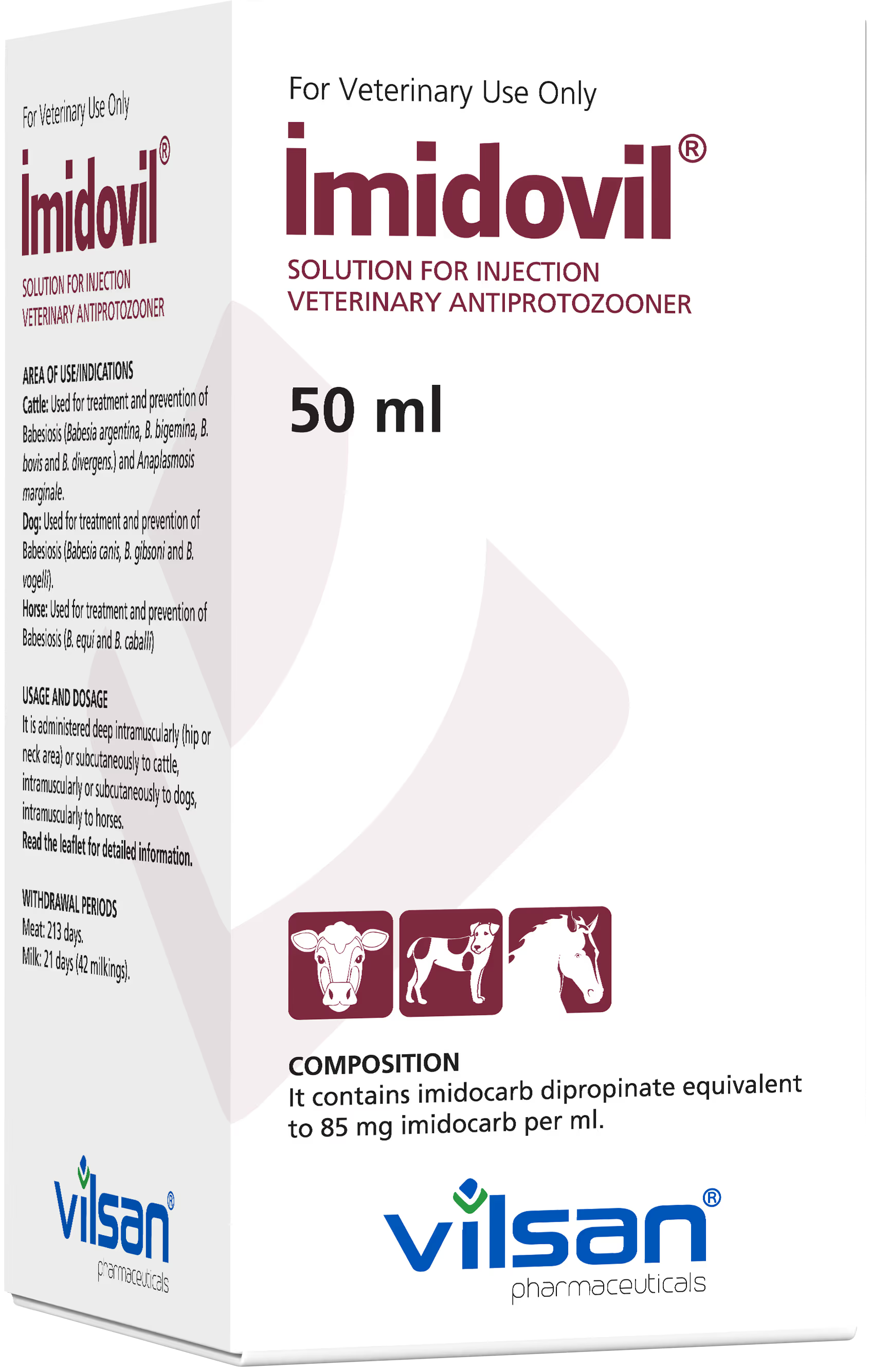
| Pharmaceutical Form | : | Solution for Injection |
| Active Ingredient | : | Imidocarb dipropionate |
| Target Animal | : | Cattle, Horse, Dog |
| Package Form | : | 20 ml and 50 ml amber glass vials |
COMPOSITION
It is a colorless or light yellow clear solution, containing imidocarb dipropinate equivalent to 85 mg imidocarb per ml.
PHARMACOLOGICAL PROPERTIES
Pharmacodynamic Properties
Imidocarb is an antiprotozoal agent belonging to the carbamates group and used in the treatment of babesiosis.
Little is known about its mechanism of action. It affects the morphology of the cytoplasm and the number and size of the nuclei in parasites. The antiprotozoal effect is mediated by its influence on the parasite's glycolysis. After penetration into the parasite via urine-based protein carriers, it acts as an inhibitor of Type II topoisomerase. This effect blocks DNA replication and inhibits the parasite's polyamine synthesis.
Pharmacokinetics Properties
Pharmacokinetic studies have shown that imidocarb has long-term activity due to its binding to plasma and tissue proteins and slow metabolism. In a radioactively labeled
study, half of the dose administered 10 days after subcutaneous administration of 3 mg/kg imidocarb to lactating and non-lactating cows was excreted. It is primarily excreted in feces. Plasma peak levels are reached 1 hour after administration (1.3 mg equivalent/kg). Peak levels in milk are reached 24 hours after administration (0.37 mg equivalent/kg) and decrease to half levels after 24 hours. It is primarily excreted in its parent compound form.
Imidocarb has been shown to cross the placental barrier.
AREA OF USE/INDICATIONS
Cattle: Used for treatment and prevention of Babesiosis (Babesia argentina, B. bigemina, B. bovis and B. divergens.) and Anaplasmosis marginale.
Dog: Used for treatment and prevention of Babesiosis (Babesia canis, B. gibsoni and B. vogelli).
Horse: Used for treatment and prevention of Babesiosis (B. equi and B. caballi)
USAGE AND DOSAGE
Cattle:
Babesiosis: Administered deep intramuscularly (hip or neck area) or subcutaneously.
Prevention: 2.125 mg imidocarb/kg body weight (1 ml for 100 kg body weight)
Treatment: 0,85 mg imidocarb/kg body weight (1 ml for 100 kg body weight) is administered once.
Anaplasmosis:
- Bovine anaplasmosis: 2,125 mg imidocarb/kg body weight (2,5 ml for 100 kg body weight)
Dog:
Babesiosis: It is administered intramuscularly or subcutaneously
Prevention: 4,25 mg imidocarb/kg body weight (0,5 ml for 10 kg body weight). Prevention should not be exceeded 4-6 weeks.
Treatment: 2,125 mg imidocarb/kg body weight (0,25 ml for 10 kg body weight) is administered once.
Horse:
It is administered intramuscularly. For B. caballi, a single dose of 2 ml for 100 kg body weight is usually sufficient. However, for B. equi, two applications may be necessary at intervals of 24-72 hours, depending on the clinical condition of the disease. A single dose provides protection for up to 4 weeks. For the sterilization of B. caballi infestations, two administration of 2 ml for 100 kg body weight at 24-hour intervals are required, while for the sterilization of B. equi infestations, four applications of 4 ml for 100 kg of body weight at 72-hour intervals are required.
In resistant cases in horses, there should be at least 6 weeks between subsequent sterilization applications.
SPECIAL CLINICAL INFORMATION AND SPECIAL WARNINGS FOR TARGET SPECIES
Imidocarb is an effective inhibitor of cholinesterase. The amount to be applied varies depending on the target species and purpose. In any case, high importance should be given to application based on live weight.
For protection against babesiosis, it should be applied when symptoms are observed in one or two animals in the herd or when cattle are transported to areas where Babesia is present. A protective dose should be administered to all animals, and all animals should be kept under observation for the specified quarantine period.
The application provides protective effects for up to 4 weeks, depending on the severity of exposure to the parasite. Immunity can be achieved if sufficient exposure to the parasite occurs during this period.
Body weight should be measured accurately, and the recommended dose should not be exceeded.
Do not use in combination with other babesicides. High-dose administration may be painful and may cause animals to react. Some dogs may be overly sensitive to this pain.
Use during pregnancy: No evidence of teratogenicity has been found in studies conducted on laboratory animals. The safety of this product has not been studied in pregnant animals of the target species. Therefore, it should be used according to the veterinarian's benefit/risk assessment.
ADVERSE EFFECTS
General disorders (hyperthermia, sweating, fatigue), digestive system disorders (vomiting, colic, hypersalivation), and neuromuscular disorders (tremor, convulsions) have been observed in target species. Salivation, restlessness, muscle tremors, tachycardia, coughing, and colic are rare. Deaths due to anaphylactic shock have been reported following administration of the product.
It is recommended that the veterinarian monitor the animals for 15 minutes after administration.
Cholinergic effects observed in animals after administration may be alleviated with atropine sulfate.
DRUG INTERACTIONS
Do not use in combination with cholinesterase inhibitors.
Should not be mixed with other medicinal products.
SYMPTOMS OF OVERDOSE, PRECAUTIONS AND ANTIDOTE
At 1.75 times the recommended dose, symptoms associated with anticholinergic activity begin to appear. Overdose can be treated with atropine sulfate. Death occurs at 5 times or more of the recommended dose.
WITHDRAWAL PERIODS
Meat: 213 days.
Milk: 21 days (42 milkings).
CONTRAINDICATIONS
Not for use in mules and donkeys. Not for use in horses under 1 year of age.
Do not administer intravenously.
Do not administer repeated doses.
Not for use in animals known to be sensitive to the active or excipient ingredients.
GENERAL WARNINGS
Consult a veterinarian before use and if any unexpected effects are observed. Keep out of reach of children and away from foodstuffs.
PRECAUTIONS TO BE TAKEN BY THE ADMINISTRATOR AND WARNINGS FOR VETERINARY SURGEON
If you have received medical advice not to work with products that exhibit anticholinesterase activity, do not use this product or come into contact with it.
In case of contact with skin or eyes, rinse the area thoroughly with water. Use appropriate protective equipment when using the product. In case of accidental injection, seek medical assistance immediately and show the product label and package insert to your doctor.
If symptoms such as hypersalivation, headache, abdominal pain, mydriasis, vomiting, blurred vision, and muscle tremors, which indicate anticholinesterase activity, occur, seek immediate medical treatment.
STORAGE CONDITIONS AND SHELF LIFE
It should be stored in the original packages, protected from light, and stored at 2 – 8 °C. For short-term storage (for use on animals), store below 25°C and protect from light. Shelf life is 18 months.
DISPOSAL AFTER USE AND WARNINGS FOR NON-TARGET SPECIES
Used or leftover product should be disposed of according to the relevant regulations.
COMMERCIAL PRESENTATION FORM
20 ml and 50 ml amber-colored glass vials with stoppers and flip-off in boxes.
PLACE AND CONDITIONS OF SALE
It is sold in pharmacies and veterinary clinics with a veterinarian's prescription. (VSP)
APPROVAL DATE OF LEAFET: 18.04.2025
MARKETING AUTHORIZATION DATE AND NO: 27.04.2007 – 018/0019
MARKETING AUTHORIZATION HOLDER
VİLSAN Veteriner İlaçları Tic. ve San. A.Ş.
Balıkhisar Mah. Balıkhisar Köy İçi Küme Evleri No:765A Akyurt/Ankara-Türkiye
MANUFACTURER COMPANY
VİLSAN Veteriner İlaçları Tic. ve San. A.Ş.
Balıkhisar Mah. Balıkhisar Köy İçi Küme Evleri No:765A Akyurt/Ankara-Türkiye
Made in Turkiye