| - | - | - |
|---|---|---|
| Product Group | : | Antibacterials |
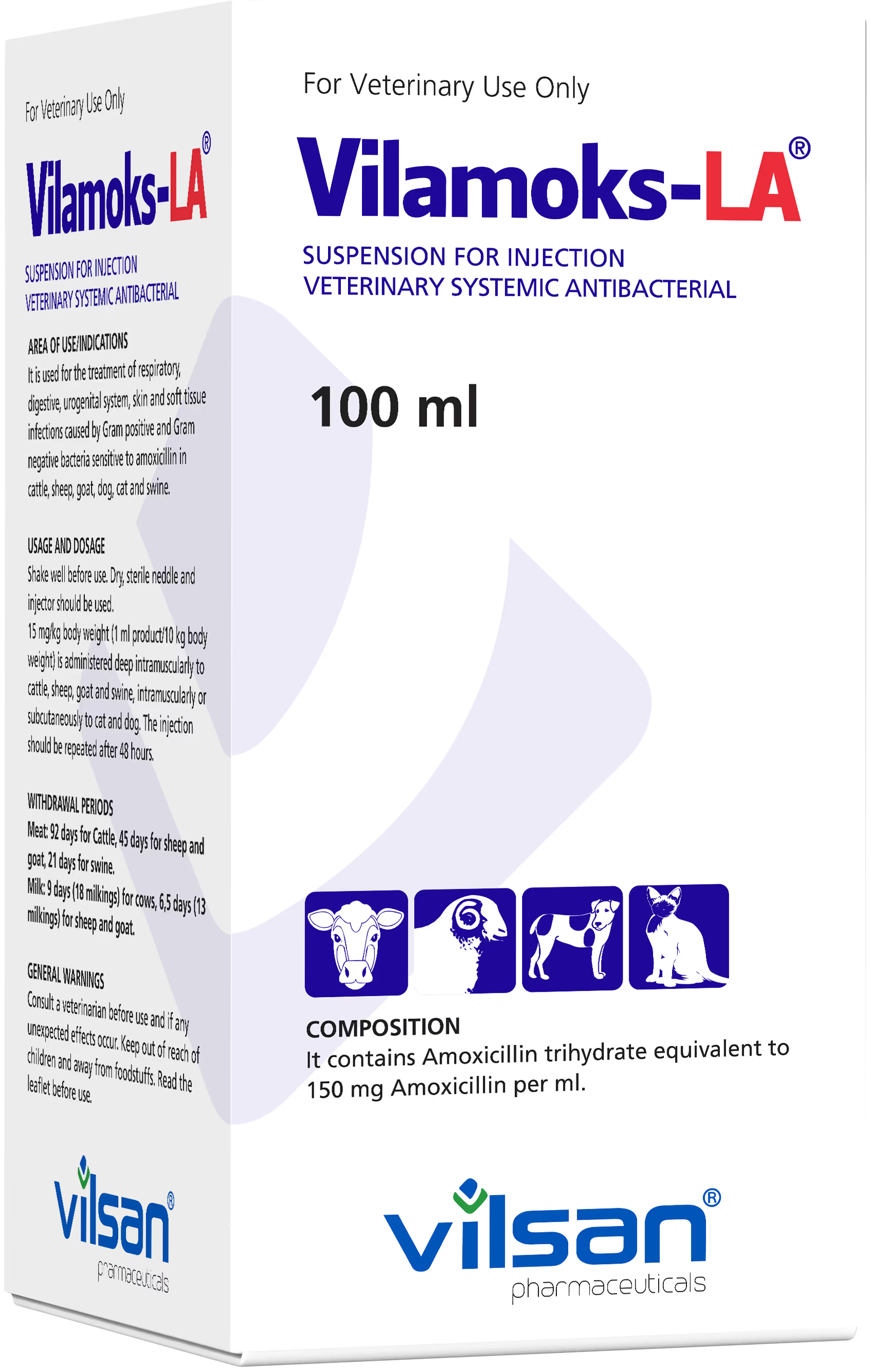
| Pharmaceutical Form | : | Suspension for Injection |
| Active Ingredient | : | Amoxicillin trihydrate |
| Target Animal | : | Cattle, Sheep, Dog, Cat, Goat |
| Package Form | : | 50 ml, 100 ml, 250 ml in colorless glass vials |
COMPOSITION
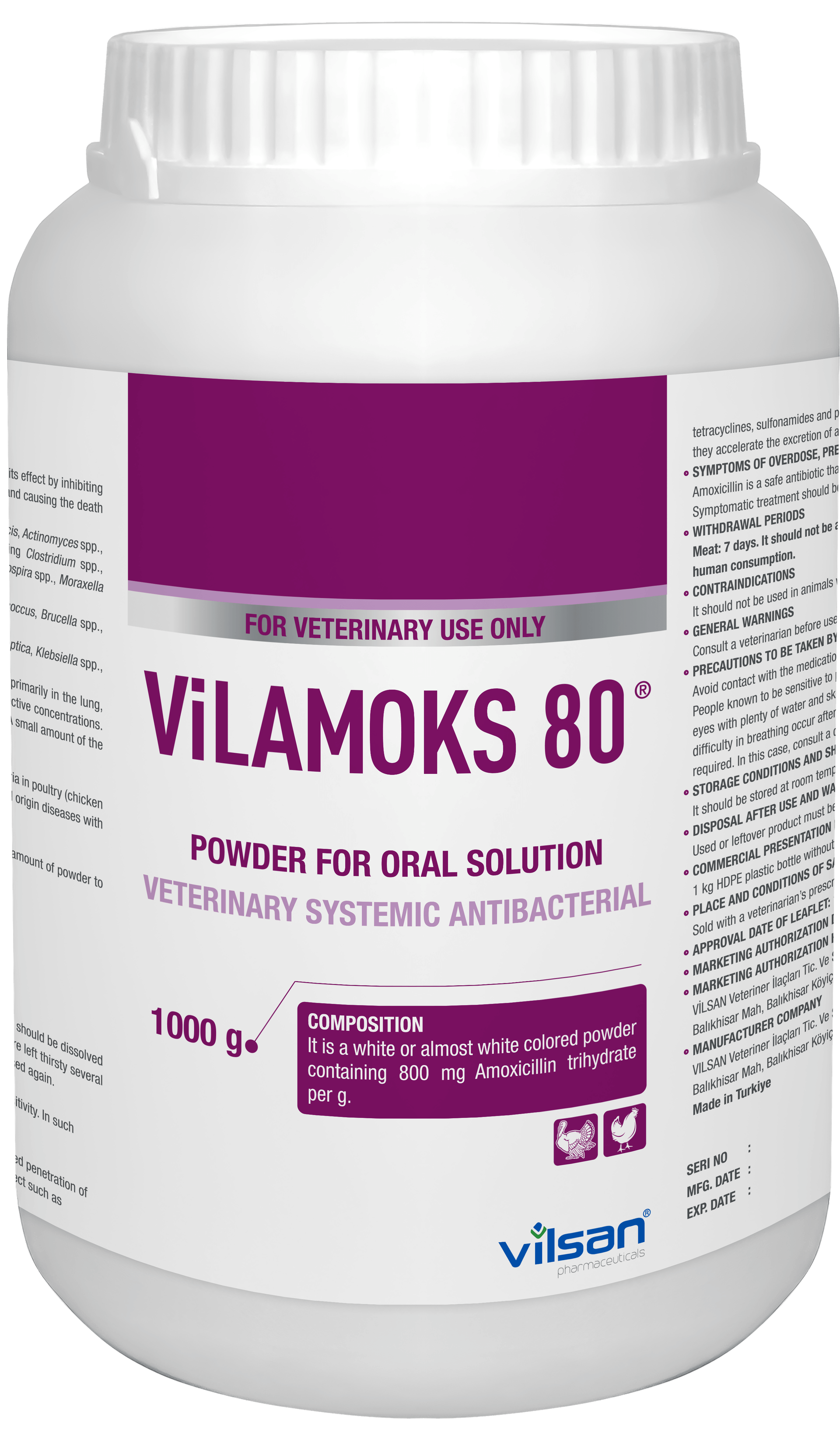
Vilamoks 80 is a white or almost-white powder containing 800 mg of Amoxicillin trihydrate per gram.
PHARMACOLOGICAL PROPERTIES
Pharmacodynamic Properties
Amoxicillin is a time-dependent bactericidal antibiotic. It exerts its effect by inhibiting the synthesis of the bacterial cell wall during replication. In Gram-positive bacteria, it prevents the formation of bridges between linear polymer chains that make up the peptidoglycan cell wall. It has a broad spectrum of activity. It also acts against a limited number of Gram-negative bacteria, whose outer cell wall is composed of lipopolysaccharides and proteins.
Resistance to beta-lactams develops through three mechanisms: beta-lactamase production, changes and/or expression in penicillin-binding proteins, and reduced permeability in the outer membrane. The most significant mechanism is the production of beta-lactamase enzymes, which inactivate penicillins by binding to the beta-lactam ring. These enzymes can be encoded by chromosomal or plasmid genes.
There is cross-resistance between amoxicillin and other penicillins, especially aminopenicillins. The use of extended-spectrum beta-lactam drugs (such as aminopenicillins) can lead to the emergence of multi-resistant bacterial phenotypes (e.g., Extended Spectrum Beta-Lactamases (ESBLs)).
Pharmacokinetics Properties
Amoxicillin is rapidly absorbed and reaches its maximum plasma concentration within 2 hours. It distributes widely throughout the body, reaching high concentrations in urine, bile, liver, and kidneys. It is primarily excreted in its active form through the kidneys. In birds, it is eliminated more quickly compared to mammals.
AREA OF USE/INDICATIONS
It is used for the treatment of infections caused by amoxicillin-sensitive bacteria in calves (those that have not yet started rumination), chickens, turkeys, and ducks.
USAGE AND DOSAGE
Chicken, Turkey, and Duck:
The product is administered via drinking water. The medicated water should be prepared just before use with clean water. Any medicated water that is not consumed within 24 hours should be discarded and replaced with fresh medicated water. During the treatment, the medicated water should be the only source of drinking water for the animals. However, if the medicated water is consumed quickly, normal water supply can be resumed. Animals should be deprived of water for 2 hours before administering the medicated water (this time may be shorter in hot weather).
Ensure that the product is fully dissolved in water.
Chicken:
The recommended dose is 15 mg/kg of amoxicillin trihydrate per day (18.75 mg/kg of product per day). Practically, for every 1000 kg of body weight, 18.75 grams of the product is mixed into the drinking water per day. The treatment duration is 3 days, and in cases of severe infections, it may be extended to 5 days.
Turkey:
The recommended dose is 15-20 mg/kg of amoxicillin trihydrate per day (18.75–25 mg/kg of product per day). Practically, for every 1000 kg of body weight, 18.75-25 grams of the product is mixed into the drinking water per day. The treatment duration is 3 days, and in cases of severe infections, it may be extended to 5 days.
Duck:
The recommended dose is 20 mg/kg of amoxicillin trihydrate per day (25 mg/kg of product per day). Practically, for every 1000 kg of body weight, 25 grams of the product is mixed into the drinking water per day. The treatment duration is 3 days.
When preparing the medicated water, it is important to accurately calculate the body weight of the animals being treated and their daily water consumption. Water consumption can vary based on factors such as breed, age, living conditions, and health status. These factors must be carefully considered to ensure correct dosage.
At the end of the treatment, the water system should be cleaned to avoid sub-therapeutic doses.
Calf:
The medication is added to water, milk, or milk replacer. The recommended dose is 12 mg/kg/day of body weight. The daily dose is divided into two equal portions and administered in the morning and evening. The treatment duration is 5 days. If no improvement is observed within the first 48 hours, the diagnosis and treatment should be reviewed. Practically, 0.5 grams of product is used for every 65 kg of body weight, given in the morning and evening. Medicated water, milk, or milk replacer should be freshly prepared before each use. The maximum solubility of the product at 20°C is 8 g/L.
SPECIAL CLINICAL INFORMATION AND SPECIAL WARNINGS FOR TARGET SPECIES
In sick animals, the intake of medicated water may vary depending on the clinical condition.
To ensure the correct dosage is administered, the concentration of amoxicillin should be accurately calculated.
It is not effective against beta-lactamase producing microorganisms.
National and regional official antimicrobial policies should be considered when using the product.
This product should be used based on the results of sensitivity tests performed on bacteria derived from the animals.
If this is not possible, the treatment should be based on regional epidemiological sensitivity data for the target bacteria.
Failure to use this product in accordance with the instructions outlined in the product characteristics summary may lead to the development of amoxicillin-resistant bacteria and reduced treatment effectiveness.
Use during pregnancy: Laboratory studies on rats have shown no evidence of teratogenicity for amoxicillin. It should be used based on a veterinary assessment of the benefit/risk ratio.
ADVERSE EFFECTS
Penicillins and cephalosporins can rarely cause hypersensitivity reactions, which may be very severe. Very rarely, changes in the intestinal flora may lead to gastrointestinal disturbances (such as diarrhea).
DRUG INTERACTIONS
This product should not be used in combination with bacteriostatic antibiotics such as tetracyclines, macrolides, and sulfonamides. There is synergy between this product and aminoglycosides. However, orally administered neomycin inhibits the absorption of orally administered penicillins. This product should not be mixed with other products.
SYMPTOMS OF OVERDOSE, PRECAUTIONS AND ANTIDOTE
There is no specific antidote. Treatment involves discontinuing the medication and providing symptomatic care. No side effects have been observed when the recommended dose was administered at five times the usual amount.
WITHDRAWAL PERIODS
Meat: 1 day for chicken, 5 days for turkey, 9 days for duck and 4 days for calves.
This product should not be used in poultry producing eggs for human consumption. In laying hens, it should not be used less than 4 weeks before the start of egg-laying.
CONTRAINDICATIONS
It is not used in rabbits, hamsters, gerbils, and guinea pigs.
It is not used in animals known to be sensitive to penicillins or other beta-lactams, or to any excipients present in the formulation.
It is not used in kidney diseases, including anuria or oliguria.
It is not used in horses and ruminants.
It is not used in the presence of beta-lactamase producing bacteria.
GENERAL WARNINGS
Consult a veterinarian before use and if any unexpected effects occur. Keep out of reach of children.
PRECAUTIONS TO BE TAKEN BY THE ADMINISTRATOR AND WARNINGS FOR VETERINARY SURGEON
Avoid inhaling the product. Use gloves and a mask that comply with standards (single-use half-mask respirator according to EN 149 or a respirator with a filter according to EN 143 and compliant with EN 140). Avoid contact with the product and medicated water. In case of contact with the product or medicated water, wash the affected area thoroughly with plenty of water. Wash your hands after use. Do not eat, drink, or smoke while using the product.
Penicillins and cephalosporins may cause hypersensitivity reactions after injection, inhalation, oral intake, or skin contact. Hypersensitivity to penicillins may lead to hypersensitivity to cephalosporins (or vice versa). Allergic reactions are rarely severe.
Persons who are allergic or advised not to come into contact with such products should not handle them.
Use this product with great care, taking all necessary precautions to avoid exposure.
If symptoms like redness occur on the skin after exposure, seek medical treatment and show this warning to your doctor. Swelling of the face, lips, or eyes, or difficulty breathing are very serious symptoms and require urgent medical attention.
STORAGE CONDITIONS AND SHELF LIFE
Before and after opening, it should be stored in the original packages, below 25°C, away from sunlight, without refrigeration or freezing. The shelf life is 2 years.
DISPOSAL AFTER USE AND WARNINGS FOR NON-TARGET SPECIES
Used or leftover product must be disposed of according to the relevant legislation.
COMMERCIAL PRESENTATION FORM
It is presented in 1 kg white polyethylene jars without a box.
PLACE AND CONDITIONS OF SALE
It is sold in pharmacies and veterinary clinics with a veterinarian's prescription. (VSP)
APPROVAL DATE OF LEAFLET: 31.03.2022
MARKETING AUTHORIZATION DATE AND NO: 12.05.2011 – 024/0029
MARKETING AUTHORIZATION HOLDER
VİLSAN Veteriner İlaçları Tic. ve San. A.Ş.
Balıkhisar Mah. Balıkhisar Köy İçi Küme Evleri No:765A Akyurt/Ankara-Türkiye
MANUFACTURER COMPANY
VİLSAN Veteriner İlaçları Tic. ve San. A.Ş.
Balıkhisar Mah. Balıkhisar Köy İçi Küme Evleri No:765A Akyurt/Ankara-Türkiye
Made in Turkiye