| - | - | - |
|---|---|---|
| Product Group | : | Antibacterials |
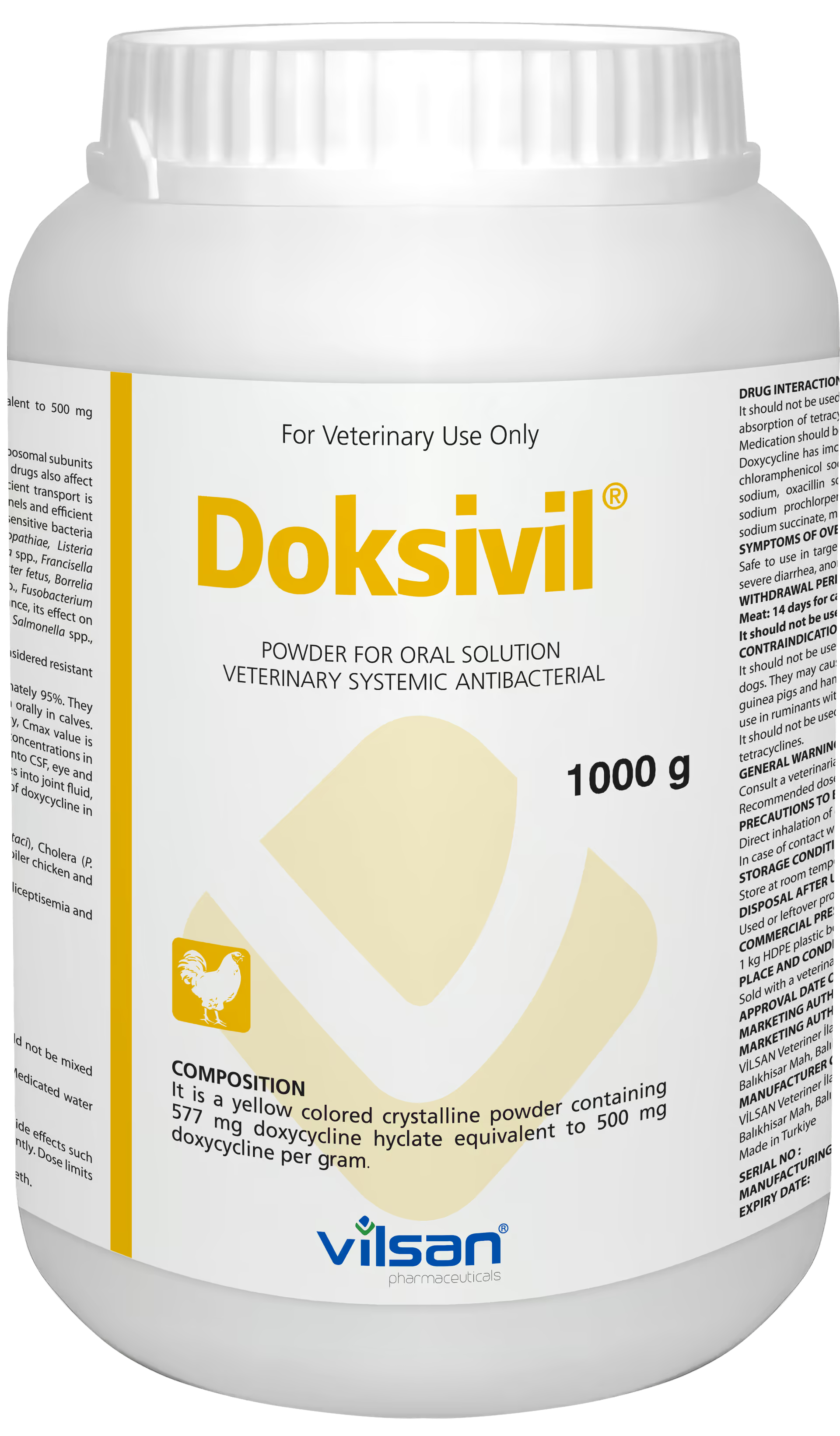
| Pharmaceutical Form | : | Powder for Oral Solution |
| Active Ingredient | : | Doxycycline hyclate |
| Target Animal | : | Calf, Chicken, Turkey |
| Package Form | : | 1000 g HDPE lock jar |
COMPOSITION
Doksivil is a yellow powder, containing 577 mg Doxycycline hyclate equivalent to 500 mg Doxycycline per gram.
PHARMACOLOGICAL PROPERTIES
Pharmacodynamic Properties
Doxycycline is a broad-spectrum antibiotic belonging to the tetracycline group. It exerts a bacteriostatic effect by binding to the 30-S ribosomal subunit in bacteria. Four mechanisms of acquired resistance to tetracyclines by microorganisms have been reported: reduced accumulation through active efflux and decreased permeability of the bacterial cell wall, protection of the bacterial ribosome, enzymatic inactivation of the antibiotic, and rRNA mutation preventing the binding of tetracyclines to ribosomes. Resistance to tetracyclines is acquired through mobile elements such as plasmids or conjugative transposons. Cross-resistance among tetracyclines has been reported.
Pharmacokinetics Properties
Doxycycline is rapidly and completely absorbed from the intestines. The presence of food in the intestines has no effect on the absorption of doxycycline. Its distribution and penetration into most body tissues are quite good. Following absorption, it is almost not metabolized. Unlike other tetracyclines, it is primarily excreted through feces.
Calves: At a dose of 10 mg/kg body weight/day for 5 days, the elimination half-life was observed to be between 15-28 hours. The plasma concentration was found to be on average 2.2 - 2.5 μg/ml.
Chickens: Six hours after the start of treatment, the plasma concentration reached 2.05 ± 0.47 μg/ml, and at a dose of 25 mg/kg body weight/day for 5 days, it ranged between 1.28 and 2.18 μg/ml.
Turkeys: When administered through drinking water for 5 days at the treatment dose, the average plasma concentration during the treatment period was determined to be 2.24±1.02 µg/ml.
AREA OF USE/INDICATIONS
It is used in the treatment of digestive and respiratory system infections caused by the sensitive bacteria listed below.
Calves with no rumen activity:
- Bronchopneumonia and pleuropneumonia caused by Pasteurella spp., Streptococcus spp., Arcanobacterium pyogenes, Histophilus somni, and Mycoplasma spp.
Chickens:
Respiratory system infections caused by Mycoplasma spp., Escherichia coli, Haemophilus paragallinarum, Bordetella avium,
Digestive system infections caused by Clostridium perfringens and Clostridium colinum.
- Also used to reduce lesions and morbidity in the respiratory system caused by Ornithobacterium rhinotracheale.
Turkeys:
Respiratory system infection caused by Mycoplasma gallisepticum.
USAGE AND DOSAGE
It is administered by mixing with milk substitute food and/or drinking water.
Calve: 10 mg doxycycline /kg body weight/day (20 mg product/kg body weight/day) for 3-5 days, daily dose is divided.
Chicken: 25 mg doxycycline /kg body weight/day (45 mg product/kg body weight/day) 3-5 days, daily dose is divided.
Turkey: 29 mg doxycycline /kg body weight/day (50 mg product/kg body weight/day) for 3-5 days.
In the application with drinking water, the practical dose can be calculated according to the formula given below;
….mg product/kg body weight/day x average live weight of the animals to be treated (kg)/ Daily water consumption per animal (liters) = Amount of product to be added to each liter of drinking water.
For accurate dosing, the body weight of the animals should be calculated as accurately as possible. The intake of medicated water by the animals may vary depending on clinical condition, age, gender, and ambient temperature. Therefore, to ensure the correct dosage, the concentration of the medicated water may need to be adjusted. The use of appropriately calibrated weight measurement equipment is recommended. The daily amount to be added to the medicated water should be adjusted to be consumed within 24 hours. The medicated water should be freshly prepared every 24 hours. It is recommended to first mix the product thoroughly with a small amount of water (to create a concentrated pre-mixture), and then, if necessary, dilute the mixture with the required amount of water.
Medicated milk replacer should be used immediately.
Ensure that all animals to be treated have easy access to the medicated water sources. To prevent sub-therapeutic dosing, watering equipment should be thoroughly cleaned after treatment. During the treatment period, medicated water should be the only source of water for the animals. Medicated water should not be prepared or stored in metal containers, and rusty equipment should not be used. Solubility depends on pH, and precipitation may occur in drinking water with high alkalinity.
SPECIAL CLINICAL INFORMATION AND SPECIAL WARNINGS FOR TARGET SPECIES
Prolonged and repeated use of this product should be avoided.
Due to changes in bacterial sensitivity to doxycycline, especially Ornithobacterium rhinotracheale, it is strongly recommended to perform bacteriological sampling and sensitivity testing on sick animals in the flock.
Inappropriate and unnecessary use of this product may lead to an increase in the prevalence of other tetracycline-resistant bacteria through potential cross-resistance.
High resistance to tetracyclines has been reported in E. coli isolated from chickens. Therefore, this product should be used in E. coli infections based on the results of sensitivity testing.
In cases where the target pathogens cannot be completely eradicated, treatment should be accompanied by good management practices such as hygiene rules and proper ventilation.
Use during pregnancy and lactation period: Due to accumulation in the bone tissue of young animals, the use of this product during pregnancy and lactation should be limited. In laying hens, it should not be used starting 4 weeks before the beginning of the laying period.
ADVERSE EFFECTS
Like other tetracyclines, allergic reactions and photosensitivity may occur, although rarely. In such cases, treatment should be discontinued. Long-term use may cause digestive system problems.
DRUG INTERACTIONS
Do not use with bactericidal antibiotics such as penicillin and cephalosporins. Tetracyclines form chelates with metals such as manganese, magnesium, iron, aluminum, calcium, and zinc, which affect bioavailability. Therefore, it should be administered either two hours before or after products containing these metals. Do not store drinking water in metal containers.
This product should not be used in combination with other veterinary medicinal products unless compatibility studies have been conducted.
SYMPTOMS OF OVERDOSE, PRECAUTIONS AND ANTIDOTE
Acute, sometimes fatal myocardial degeneration may occur in calves with single or repeated applications. Since this condition is mostly caused by overdose, it is important to adjust the application dose precisely. Chickens can tolerate a dose of 40 mg/kg body weight without clinical side effects. If symptoms occur due to overdose, treatment should be discontinued and appropriate symptomatic treatment administered if necessary.
WITHDRAWAL PERIODS
Meat: 5 days for chicken, 12 days for turkey and 7 days for calves. This product should not be used in poultry from which eggs are produced for human consumption. It should not be used in cattle from which milk is produced for human consumption. In laying hens, it should not be used starting 4 weeks before the beginning of the laying period.
CONTRAINDICATIONS
Do not use in animals known to be sensitive to tetracyclines and the excipients in the formulation.
Do not administer to animals with severe liver and kidney insufficiency.
GENERAL WARNINGS
Consult a veterinarian before use and if any unexpected effects occur. Keep out of reach of children.
PRECAUTIONS TO BE TAKEN BY THE ADMINISTRATOR AND WARNINGS FOR VETERINARY SURGEON
Due to the risk of contact dermatitis and hypersensitivity, necessary precautions should be taken to avoid skin contact and inhalation (breathing) during the application of the product. For this purpose, a dust mask (disposable half-mask respirator complying with EN 149 standard or a respirator with a filter complying with EN 143 standard and EN 140 standard) and gloves should be used.
In case of contact with eyes or skin, wash the affected area thoroughly with plenty of water, and if sensitivity occurs, seek medical treatment. After handling the product, wash contaminated skin and hands.
Do not smoke, eat, or drink while applying the product.
If signs such as redness appear on the skin, seek medical help and show this document to your doctor. Swelling of the face, eyes, or lips, and difficulty breathing are very serious symptoms and require immediate medical assistance.
STORAGE CONDITIONS AND SHELF LIFE
Before and after opening, it should be stored in the original packages, protected from sunlight, at a temperature below 25°C, without refrigeration or freezing. The shelf life is 2 years.
DISPOSAL AFTER USE AND WARNINGS FOR NON-TARGET SPECIES
Unused or leftover product should be disposed of in accordance with the relevant regulations.
COMMERCIAL PRESENTATION FORM
1000 g white HDPE jars with a white HDPE cover, without box.
PLACE AND CONDITIONS OF SALE
It is sold in pharmacies, veterinary clinics, polyclinics, and animal hospitals with a veterinarian's prescription (VHP).
APPROVAL DATE OF LEAFLET: 15.11.2022
MARKETING AUTHORIZATION DATE AND NO: 10.03.2008-019/0084
MARKETING AUTHORIZATION HOLDER
VİLSAN Veteriner İlaçları Tic. ve San. A.Ş.
Balıkhisar Mah. Balıkhisar Köy İçi Küme Evleri No:765A Akyurt/Ankara-Türkiye
MANUFACTURER COMPANY
VİLSAN Veteriner İlaçları Tic. ve San. A.Ş.
Balıkhisar Mah. Balıkhisar Köy İçi Küme Evleri No:765A Akyurt/Ankara-Türkiye
Made in Turkiye