| - | - | - |
|---|---|---|
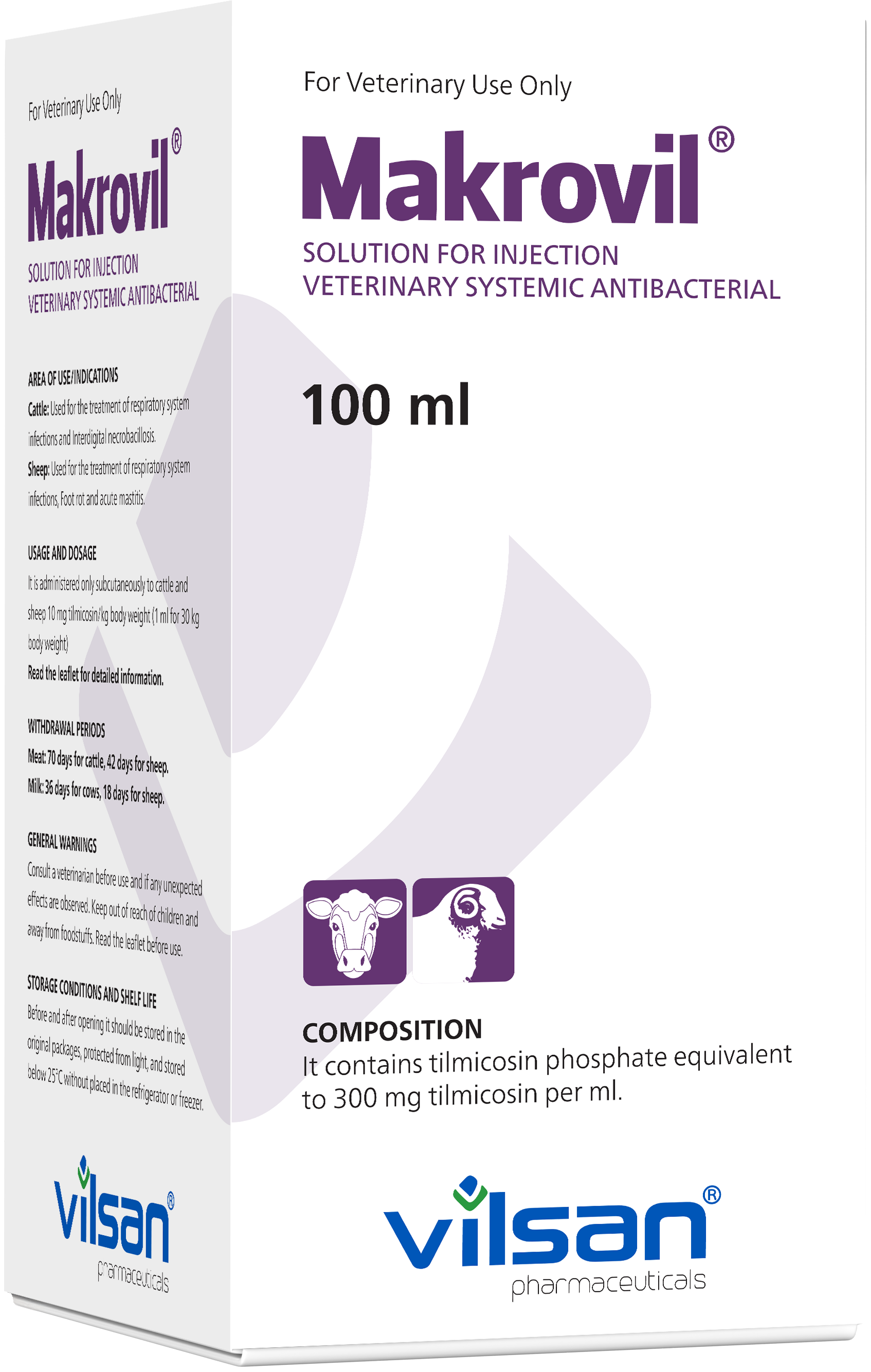
| Product Group | : | Antibacterials |
| Pharmaceutical Form | : | Solution for Injection |
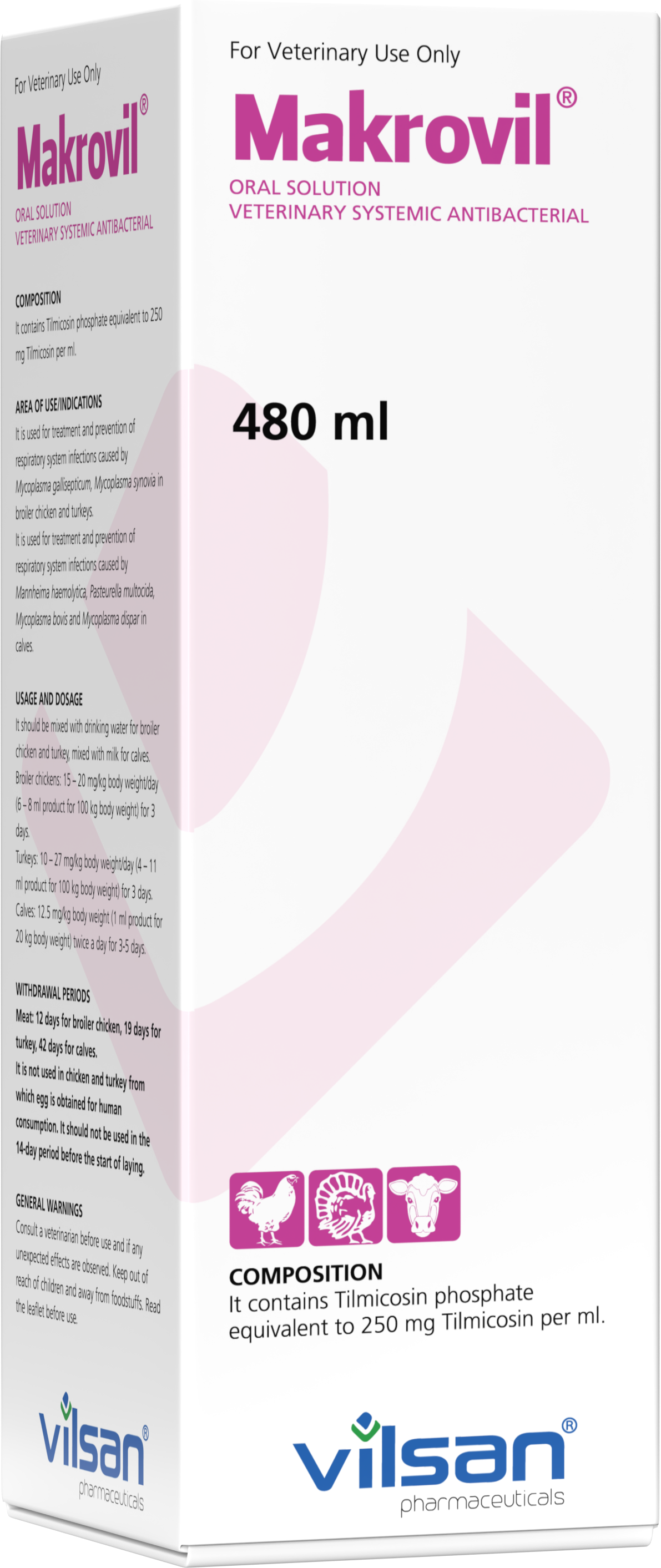
| Active Ingredient | : | Tilmicosin phosphate |
| Target Animal | : | Cattle, Sheep |
| Package Form | : | 20 ml, 50 ml, 100 ml and 250 ml Amber Colored Glass Flacons |
COMPOSITION
It is yellow to amber colored solution, containing tilmicosin phosphate equivalent to 300 mg tilmicosin per ml.
PHARMACOLOGICAL PROPERTIES
Pharmacodynamic Properties
Tilmicosin is a semi-synthetic antibiotic belonging to the macrolide group. It is thought to exert its effect by interfering with protein synthesis. It has bacteriostatic effects but exhibits bactericidal activity at high concentrations. It is effective against certain Gram-negative bacteria and Mycoplasma, primarily Gram-positive bacteria. It is particularly effective against the following bacteria originating in cattle and sheep: Mannheimia, Pasteurella, Actinomyces (Corynebacterium), Fusobacterium, Dichelobacter, Staphylococcus, and Mycoplasma.
In Europe, the MIC values for field strains isolated from cattle with respiratory system diseases between 2009 and 2012 are as follows.
|
Bacteria |
MIC (μg/ml) |
MIC50 (μg/ml) |
MIC90 (μg/ml) |
|
P. multocida |
0.5- > 64 |
4 |
8 |
|
M. haemolytica |
1 - 64 |
8 |
16 |
The Institute for Clinical and Laboratory Standards has determined the tilmicosin values for M. haemolyica, which causes bovine respiratory disease, as follows: ≤8μg/ml = susceptible, 16 μg/ml = moderately susceptible, and ≥ 32 μg/ml = resistant. Although there is no criterion for P. multocida of bovine origin, the tilmicosin values for these bacteria of porcine origin are as follows: ≤16 μg/ml = susceptible and ≥ 32 μg/ml = resistant.
Scientific studies have shown that macrolides have a synergistic effect with the host defense system. Macrolides enhance the ability of phagocytes to eliminate bacteria.
Following oral or parenteral administration, the target organ for toxicity is the heart. The primary cardiac effects are tachycardia and negative inotropic effects. Cardiovascular toxicity is due to the blockade of calcium channels.
In dogs, CaCl2 treatment has shown a positive effect on the inotropic effect in the left ventricle after tilmicosin administration, following its effects on vascular blood pressure and pulse.
Dobutamine partially counteracts the negative inotropic effect of tilmicosin in dogs. Beta-adrenergic antagonists such as propranolol exacerbate the negative inotropic effect of tilmicosin in dogs.
In pigs, intramuscular administration at a dose of 10 mg/kg caused an increase in respiratory rate, agitation, and convulsions; administration at a dose of 20 mg/kg caused death in 3 of 4 pigs; and administration at a dose of 30 mg/kg caused death in all 4 animals tested. Intravenous administration of tilmicosin at a dose of 4.5–5.6 mg/kg following 2–6 intravenous injections of 1 ml of epinephrine (1/1000) resulted in the death of all 6 animals tested. No deaths were observed in animals that did not receive epinephrine. These results indicate that intravenous epinephrine administration is contraindicated.
Cross-resistance has been observed between tilmicosin and other macrolides and lincomycin.
Pharmacokinetics Properties
The kinetic parameters for recommended dose and way of administration are as below;
|
|
Dose |
Tmax |
Cmax |
|
Cattle: Neonatal calve Beef cattle |
10 mg/kg 10 mg/kg |
1 hour 1 hour |
1.55 µg/ml 0.97 µg/ml |
|
Sheep: 40 kg 28-50 kg |
10 mg/kg 10 mg/kg |
8 hours 8 hours |
0.44 µg/ml 1.18 µg/ml |
After subcutaneous administration, tilmicosin is distributed throughout the body but reaches high concentrations in the lungs. It is converted into numerous metabolites, primarily N-demethyl tilmicosin. However, it is mainly excreted unchanged. It is mainly excreted via the bile duct and therefore in the feces, and to a lesser extent in the urine. The half-life in cattle is 2-3 days.
AREA OF USE/INDICATIONS
Cattle: Used for the treatment of respiratory system infections caused by Mannheimia haemolytica and Pasteurella multocida and Interdigital necrobacillosis.
Sheep: Used for the treatment of respiratory system infections caused by Mannheimia haemolytica and Pasteurella multocida, Foot rot caused by Dichelobacter nodosus and Fusobacterium necrophorum, acute mastitis caused by Staphylococcus aureus and Mycoplasma agalactia.
USAGE AND DOSAGE
It is administered ony subcutaneously.
10 mg tilmicosin/kg body weight (1 ml for 30 kg body weight)
Cattle: Method: Draw the required amount of product from the vial by using the syringe, leaving the needle in the vial and removing the syringe from the needle. If animals are to be treated in groups, leave the needle in the vial so that subsequent doses can be drawn into the syringe. Completely restrain the animal to be treated and insert another needle subcutaneously into the injection site (preferably in a skin fold behind the shoulder and above the rib cage). Attach the syringe to the needle and inject the product. Do not apply more than 20 ml of product to any one area.
Sheep: It is extremely important to measure the weight of lambs accurately to avoid overdosing. A 2 ml or smaller syringe can be used to ensure correct dosing.
Draw the required amount of product from the vial into the syringe, leaving the needle in the vial, and remove the syringe from the needle. Hold the animal firmly and insert another needle subcutaneously into the injection site (preferably in a skin fold behind the shoulder and above the rib cage). Attach the syringe to the needle and inject the product. Do not apply more than 2 ml of product to one area.
If improvement is not seen within 48 hours, the diagnosis should be reviewed.
Take necessary precautions to prevent contamination of the bottle during use. The bottle should be visually inspected for any particles or abnormal physical appearance; if any are found, the product should not be used.