| - | - | - |
|---|---|---|
| Product Group | : | Antibacterials |
| Pharmaceutical Form | : | Solution for Injection |
| Active Ingredient | : | Oxytetracycline dihydrate, Flunixin Meglumine |
| Target Animal | : | Cattle |
| Package Form | : | 100 ml vial |
COMPOSITION
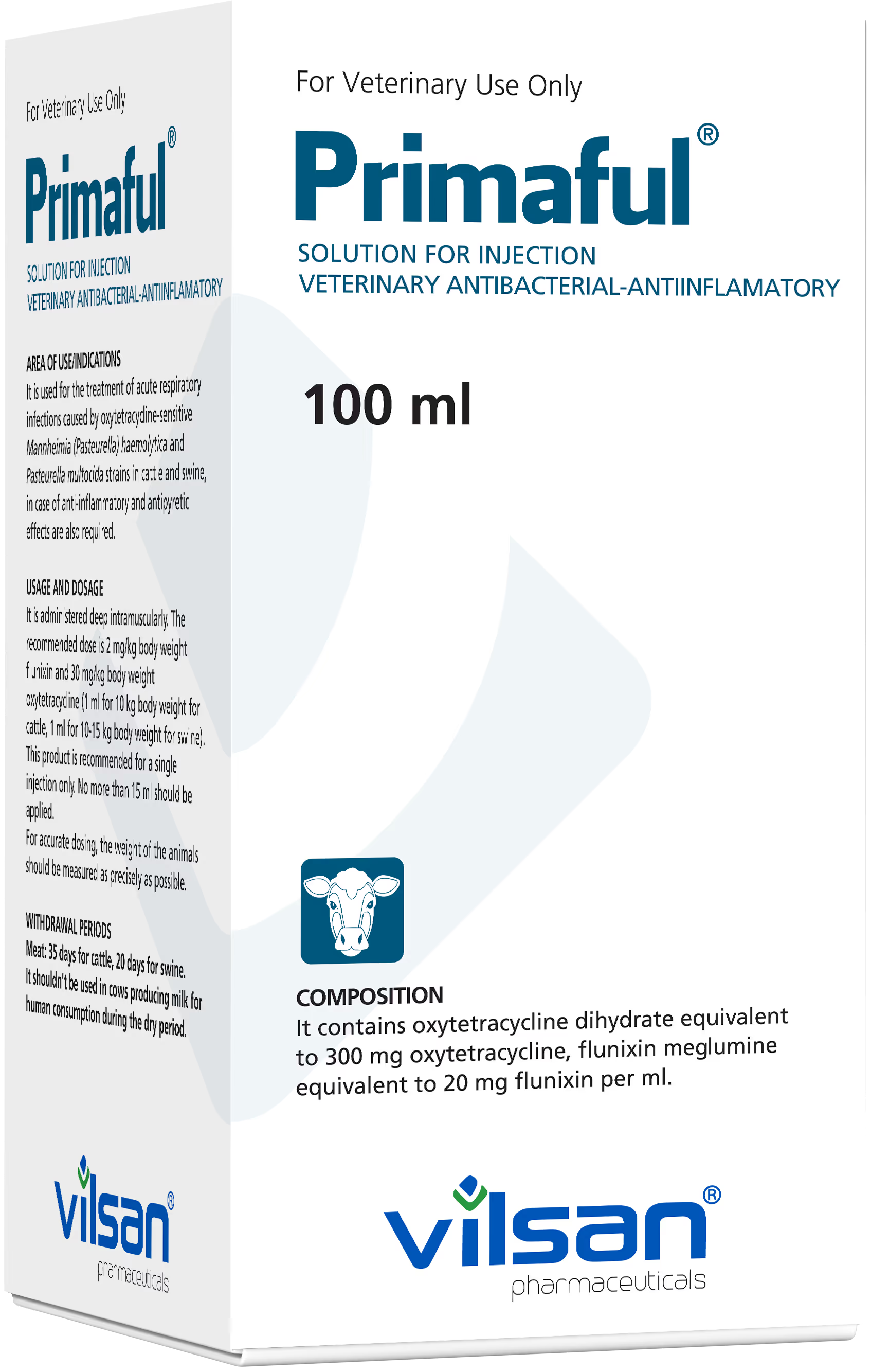
Primaful is a clear, yellow to amber colored solution, containing oxytetracycline dihydrate equivalent to 300 mg oxytetracycline and flunixin meglumine equivalent to 20 mg flunixin per ml.
PHARMACOLOGICAL PROPERTIES
Pharmacodynamic properties
Oxytetracycline is bacteriostatic and works by binding to the 30S subunit of bacterial ribosomes, thereby inhibiting bacterial protein synthesis. Numerous genes regulating resistance to tetracyclines have been identified, and these genes can be carried on plasmids or transposons between pathogenic and non-pathogenic bacteria. The most common resistance mechanism is the removal of oxytetracycline from the organism via an energy-dependent efflux pump or the protection of ribosomes from binding by a modified target site.
Resistance developed against one tetracycline can lead to cross-resistance to other tetracyclines.
Flunixin is an anti-inflammatory agent with anti-endotoxic and antipyretic properties. Flunixin exerts its effects by inhibiting the cyclo-oxygenase (prostaglandin synthetase) enzyme and preventing the synthesis of prostaglandins from their precursor, arachidonic acid. It demonstrates its antiendotoxic effects by suppressing eicosanoid formation and is therefore used in diseases involving endotoxins.
Pharmacokinetics Properties
Oxytetracycline is rapidly absorbed from the injection site and reaches peak plasma levels within 2-6 hours.
Oxytetracycline is distributed throughout the body, reaching the highest concentrations in the liver, kidneys, spleen, and lungs. It is also stored in areas where bone formation is active. It crosses the placenta and enters the fetal circulation. The plasma level in the fetus reaches approximately half that of the mother. It crosses the blood-brain barrier with difficulty.
Oxytetracycline is metabolized to varying degrees. The most commonly identified substance in tissue, feces, and urine is the parent tetracycline. Approximately 30% is excreted unchanged in feces. It reversibly binds to plasma proteins and exhibits extensive distribution. It is excreted from the blood via the liver and reaches high concentrations in the parenchyma and bile. Bile concentrations can reach up to 30 times that of the blood. The enterohepatic circulation limits bile secretion and causes therapeutic concentrations to persist for a long time.
Oxytetracycline is primarily excreted via the kidneys. It is also excreted via the feces, independent of the route of administration. Less than 2% of the administered dose passes into milk.
Flunixin binds extensively to plasma proteins, resulting in a generally low distribution volume. The free fraction distributes to all body fluids, including the central nervous system. It tends to accumulate in inflamed tissue. Flunixin is primarily excreted via feces and subsequently via urine.
AREA OF USE/INDICATIONS
It is used for the treatment of acute respiratory infections caused by oxytetracycline-sensitive Mannheimia (Pasteurella) haemolytica and Pasteurella multocida strains in cattle, in case of anti-inflammatory and antipyretic effects are also required.
USAGE AND DOSAGE
It is administered deep intramuscularly. The recommended dose is 2 mg/kg body weight flunixin and 30 mg/kg body weight oxytetracycline (1 ml for each 10 kg body weight). This product is recommended for a single injection only. No more than 15 ml should be applied.
For accurate dosing, the weight of the animals should be measured as precisely as possible.
SPECIAL CLINICAL INFORMATION AND SPECIAL WARNINGS FOR TARGET SPECIES
Use this product according to the sensitivity test results of bacteria obtained from the animals. If this is not possible, it should be used based on regional sensitivity data related to the target bacteria.
Local or national antimicrobial policies should be taken into account when using this product.
Using this product in a manner different from the summary of product characteristics may increase the prevalence of oxytetracycline-resistant bacteria and, due to potential cross-resistance, reduce the effectiveness of treatment with other tetracyclines.
Do not use in dehydrated, hypovolemic, or hypotensive animals due to the potential for increased renal toxicity. Avoid concomitant use with potentially nephrotoxic drugs.
Do not exceed the specified dose and duration.
Repeated daily use of this product in calves that have not yet begun rumination causes erosion of the abomasum. Therefore, it should be used with caution in these animals.
The use of this product in calves younger than 6 weeks carries significant risk and should be avoided. If necessary, the dose may be reduced, and careful clinical observation is required.
Since it inhibits prostaglandin synthesis, it should not be used in animals under general anesthesia until they have fully recovered from the effects of anesthesia.
Use during pregnancy and lactation: The safety of this product has not been established in cattle during pregnancy, lactation, ovulation, or in breeding animals. Laboratory studies conducted in rabbits and rats with the excipient N-methyl-2-pyrrolidone have shown evidence of fetotoxic effects. It should only be used based on a benefit-risk assessment by a responsible veterinarian.
No evidence of embryotoxic or teratogenic effects has been found in laboratory animal studies with flunixin and oxytetracycline.
Oxytetracycline easily crosses the placenta and enters the fetal bloodstream. Tetracyclines are stored in teeth and cause discoloration, enamel hypoplasia, and reduced mineralization. Tetracyclines also delay fetal skeletal system development. Safety in pregnant animals has not been studied. Therefore, its use in pregnant animals is not recommended.
ADVERSE EFFECTS
A rare, temporary reaction may occur at the injection site. Use during the late pregnancy period, including the dental development phase, can cause discoloration of the teeth. The same applies to bones. Very rarely, allergic reactions, hepatotoxicity, and blood dyscrasias may occur.
In some cases, there may be a slight increase in body temperature after treatment. This increase is temporary.
DRUG INTERACTIONS
It should not be used with other bacteriostatic and bactericidal antimicrobials. Products containing divalent or trivalent cations (Mg, Fe, Al, Ca) should not be mixed with tetracyclines, as these cations form chelates with tetracyclines. Avoid concomitant use with potentially nephrotoxic drugs. Some non-steroidal anti-inflammatory drugs bind to plasma proteins at high rates and compete with other drugs that bind to proteins at high rates, which may increase toxicity.
Do not use concomitantly with other non-steroidal anti-inflammatory drugs; if used, ensure that there is a 24-hour interval between applications.
Do not mix with other products.
SYMPTOMS OF OVERDOSE, PRECAUTIONS AND ANTIDOTE
It has been found that twice the recommended dose is well tolerated. At twice the recommended dose, temporary diarrhea may occur with or without apathy. This resolves spontaneously within 2-3 days without the need for additional treatment. There is no specific antidote; symptomatic treatment is administered in cases of overdose. A temporary and generally moderate reaction may occur at the injection site, which may persist for a longer duration than the residual clearance period. There is no specific antidote in cases of overdose; symptomatic treatment may be administered.
WITHDRAWAL PERIODS
It shouldn’t be used in cows producing milk for human consumption during the dry period.
CONTRAINDICATIONS
Do not use in cases of hepatic and renal failure.
Do not use in cases where there are signs of hemostasis disorder or in cases where there is a risk of bleeding in the digestive system.
Do not use in animals with heart disease.
Do not use in animals known to be sensitive to the active or auxiliary ingredients in the composition.
GENERAL WARNINGS
Consult a veterinarian before use and if any unexpected effects occur. Keep out of reach of children and away from foodstuffs.
PRECAUTIONS TO BE TAKEN BY THE ADMINISTRATOR AND WARNINGS FOR VETERINARY SURGEON
Laboratory studies conducted in rabbits and rats with the excipient N-methyl-2-pyrrolidone have shown evidence of fetotoxic effects. Women of childbearing age, pregnant women, or women who may become pregnant should take the utmost care and take all precautions to prevent accidental self-injection and contact with the product.
This product may cause sensitivity. Wash your hands after use. In case of contact with skin or eyes, rinse immediately with plenty of water. Individuals sensitive to tetracyclines and non-steroidal anti-inflammatory drugs should avoid contact with the product. Reactions may be severe.
Avoid accidental injection. In case of accidental self-injection, seek immediate medical attention and show the product leaflet or label to your doctor.
Laboratory studies in rabbits and rats with the excipient N-methylpyrrolidone have shown evidence of fetotoxic effects. Women of childbearing age, pregnant women, or women who may become pregnant should exercise extreme caution and take all necessary precautions to prevent accidental self-injection and contact with the product.
STORAGE CONDITIONS AND SHELF LIFE
Before and after opening, the product should be stored below 25°C, in the original packages, without being frozen or placed in the refrigerator. Protect from sunlight. Shelf life is 2 years. It should be used within 28 days after opening.
DISPOSAL AFTER USE AND WARNINGS FOR NON-TARGET SPECIES
Used or remaining product should be disposed of according to the relevant regulations.
COMMERCIAL PRESENTATION FORM
100 ml amber-colored glass vials with cardboard boxes.
PLACE AND CONDITIONS OF SALE
It is sold in pharmacies and veterinary clinics with a veterinarian's prescription. (VHP)
APPROVAL DATE OF LEAFLET: 29.04.2025
MARKETING AUTHORIZATION DATE AND NO: 04.07.2002 – 11/1070
NAME AND ADDRESS OF MARKETING AUTHORIZATION HOLDER
VİLSAN Veteriner İlaçları Ticaret ve Sanayi A.Ş.
Balıkhisar Mah. Balıkhisar Köy içi Küme Evleri No: 765A Akyurt/Ankara – Türkiye
MANUFACTURER COMPANY
VİLSAN Veteriner İlaçları Ticaret ve Sanayi A.Ş.
Balıkhisar Mah. Balıkhisar Köy içi Küme Evleri No: 765A Akyurt/Ankara – Türkiye
Made in Turkiye