| - | - | - |
|---|---|---|
| Product Group | : | Clinical Products |
| Pharmaceutical Form | : | Solution for Injection |
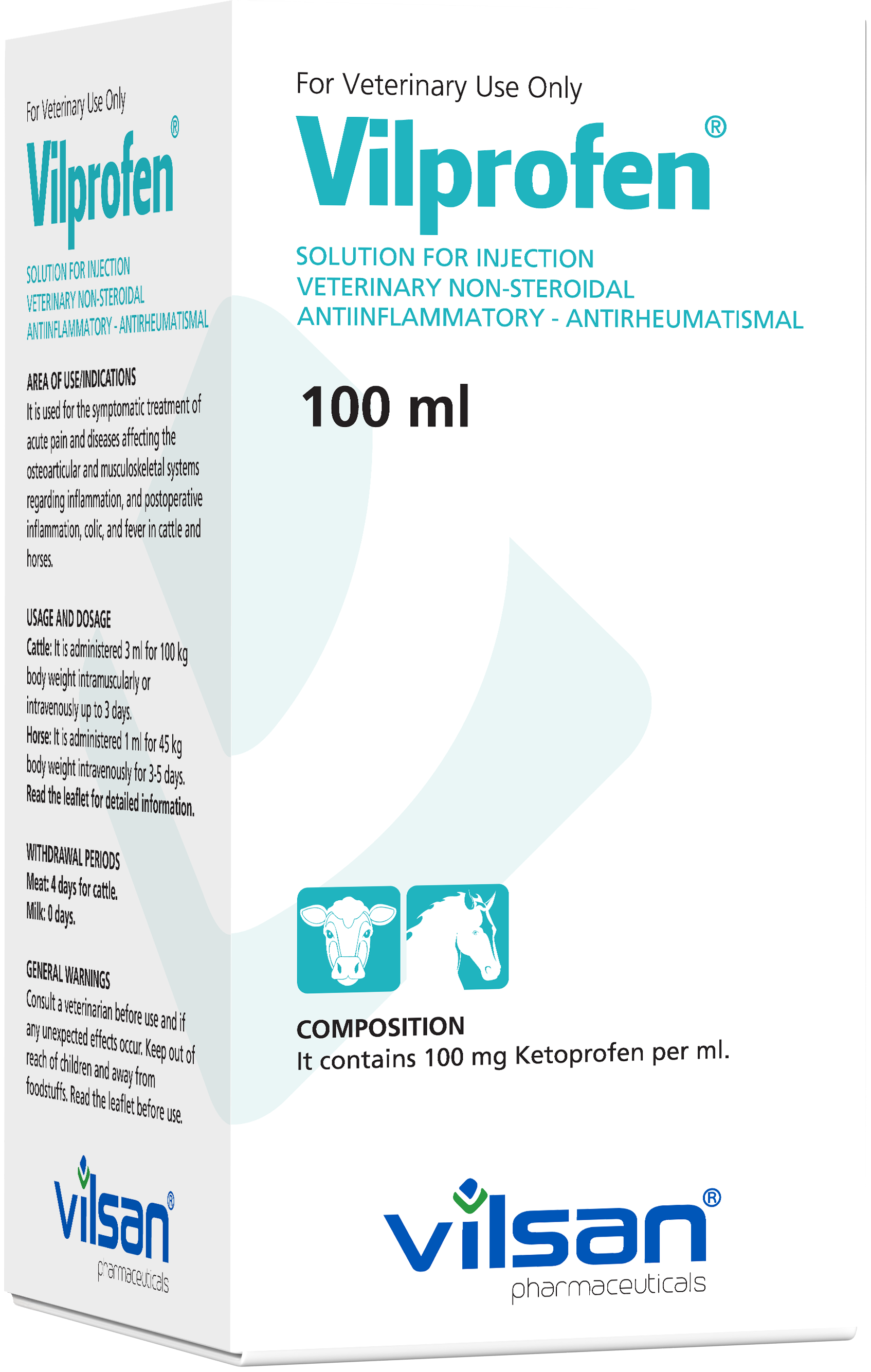
| Active Ingredient | : | Ketoprofen |
| Target Animal | : | Cattle, Horse |
| Package Form | : | 50 ml and 100 ml amber glass vials |
COMPOSITION
It is a colorless or light yellow colored clear solution, containing 100 mg Ketoprofen per ml.
PHARMACOLOGICAL PROPERTIES
Pharmacodynamic Properties
Ketoprofen is a non-steroidal anti-inflammatory drug. In addition to its anti-inflammatory effect, it also has antipyretic and analgesic effects. The exact mechanisms of action are not fully understood. The pharmacological mechanism of action of ketoprofen is based on its effect on cyclooxygenase and lipoxygenase, which partially inhibits the synthesis of prostaglandins and leukotrienes. Ketoprofen also inhibits bradykinin formation and platelet aggregation, stabilizes lysosomal membranes, thereby preventing the release of lysosomal enzymes that contribute to tissue damage.
Pharmacokinetics Properties
After intravenous injection in horses, the half-life is approximately 1 hour, the distribution volume is approximately 0.17 l/kg, and the clearance is approximately 0.3 l/kg. After intramuscular injection in cattle and pigs, ketoprofen is rapidly absorbed, and the maximum plasma concentration is approximately 11 micrograms/ml, achieved between ½ and 1 hour. The average absorption time is approximately 1 hour, and the plasma half-life is 2–2.5 hours. Following intramuscular injection, bioavailability in cattle and pigs is 90–100%. When administered at 24-hour intervals, ketoprofen exhibits linear and constant kinetics, as the above parameters remain unchanged. Approximately 95% of ketoprofen binds to plasma proteins.
Ketoprofen is primarily metabolized by reduction of the ketone group to a major metabolite. Ketoprofen is rapidly eliminated; approximately 80% is eliminated within 12 hours of administration. Approximately 90% of elimination occurs via the kidneys, primarily in the form of metabolites.
AREA OF USE/INDICATIONS
Cattle:
- Supportive treatment of birth-related birth paralysis,
- Relief of pain and fever in bacterial respiratory tract infections, in conjunction with appropriate etiological treatment,
- Support of recovery in acute clinical mastitis, including acute endotoxic mastitis caused by Gram-negative bacteria, in conjunction with appropriate etiological treatment,
- Alleviation of postpartum breast edema,
- Osteoarticular and musculoskeletal system pain,
- Facilitation of postpartum ambulation
Horse
Diseases affecting the osteoarticular and musculoskeletal systems associated with acute pain and inflammation:
- Traumatic lameness
- Arthritis
- Osteitis, knee swelling
- Tendinitis, bursitis
- Naviculitis
- Laminitis
–Myositis
It is also used for the symptomatic treatment of post-operative inflammation, colic, and fever.
USAGE AND DOSAGE
Cattle:
It is administered 3 mg/kg bodyweight (3 ml for 100 kg body weight) intramuscularly or intravenously up to 3 days.
Horse:
It is administered 2,2 mg/kg body weight (1 ml for 45 kg body weight) intravenously for 3-5 days. It should not be repeated unless clinically necessary and appropriate in cases of colic.
No more than 5 ml should be administered to one area in intramuscular administration.
It should be administered 10-30 minutes before the procedure to reduce post-operative pain.
An appropriate syringe should be used and body weight should be calculated accurately to avoid overdose.