| - | - | - |
|---|---|---|
| Product Group | : | Clinical Products |
| Pharmaceutical Form | : | Solution for Injection |
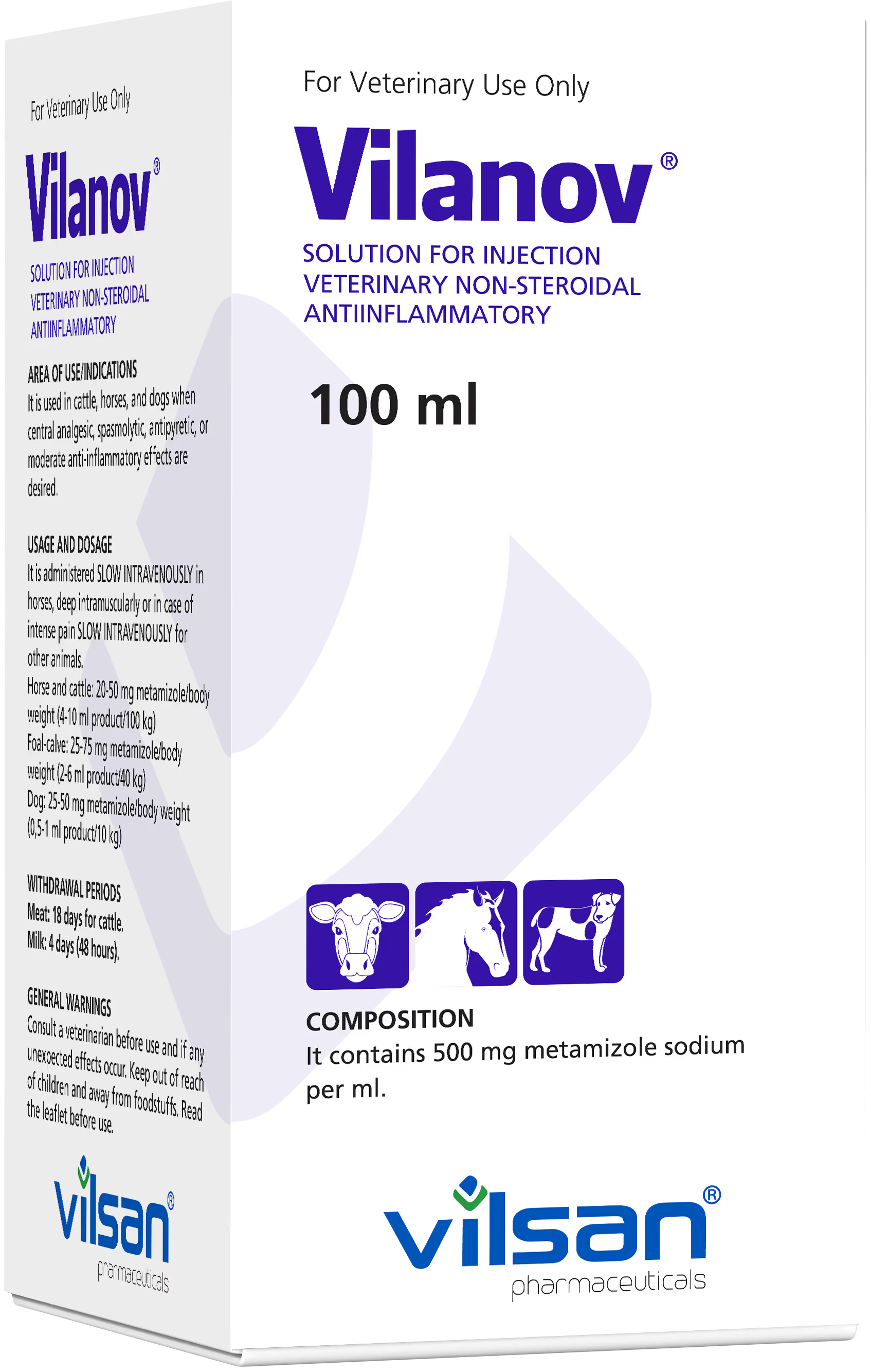
| Active Ingredient | : | Metamizole Sodium |
| Target Animal | : | Cattle, Horse, Dog |
| Package Form | : | 20 ml, 50 ml and 100 ml amber glass vials |
COMPOSITION
Vilanov is a colorless or light yellow colored clear solution, containing 500 mg metamizole sodium and 10 mg benzyl alcohol as a preservative per ml.
PHARMACOLOGICAL PROPERTIES
Pharmacodynamic Properties
Metamizole belongs to the pyrazolone derivatives group and is used as an analgesic, antipyretic, and spasmolytic. It has a significant central analgesic and antipyretic effect, but its anti-inflammatory effect is low. Metamizole inhibits the synthesis of prostaglandins by blocking cyclooxygenase. The analgesic and antipyretic effects are primarily due to the inhibition of prostaglandin E2 synthesis. Additionally, Metamizole has a spasmolytic effect on smooth muscle organs, and sodium metamizole antagonizes the effects of bradykinin and histamine.
Pharmacokinetics Properties
Metamizole is rapidly absorbed and peak blood levels can be detected after 1-2 hours. It is distributed proportionally in tissues and its concentration drops to 1-3% of maximum levels after 1-2 hours. Its metabolism via hydrolysis leads to the formation of various metabolites, the most pharmacologically important of which are methylaminoantipyrine (MAA) and aminoantipyrine (AA). In dogs, the metabolite produced in quantitatively larger amounts is 4-hydroxyantipyrine, which is also present in significant amounts in horse urine.
Metamizole and its metabolites are primarily excreted via the kidneys (85%). Approximately 15% is found in feces.
AREA OF USE/INDICATIONS
It is used in cattle, horses, and dogs when central analgesic, spasmolytic, antipyretic, or moderate anti-inflammatory effects are desired. For example:
-Treatment of acute painful inflammation of the musculoskeletal system, such as arthritis, myositis, and rheumatism,
-Treatment of general painful conditions,
-Treatment of uterine or other internal organ spasms and colic in horses as an antispasmodic,
-Treatment of spasms in cases of foreign body obstruction in the esophagus.
USAGE AND DOSAGE
It is administered SLOW INTRAVENOUSLY in horses, deep intramuscularly or in case of intense pain SLOW INTRAVENOUSLY for other animals.
Horse and cattle: 20-50 mg metamizole/body weight (4-10 ml product/100 kg)
Foal-calve: 25-75 mg metamizole/body weight (2-6 ml product/40 kg)
Dog: 25-50 mg metamizole/body weight (0,5-1 ml product/10 kg)
In case of prolonged use, the dose should be decreased because of accumulation of long-acting metabolites.
SPECIAL CLINICAL INFORMATION AND SPECIAL WARNINGS FOR TARGET SPECIES
It should only be used in calves at high risk due to stress, transport, or feeding conditions, based on a veterinarian's benefit/risk assessment. When using for racehorses, it's a good idea to check the relevant regulations.
It should not be used in animals allergic to pirazolones or in cases of abnormal blood values or bone marrow abnormalities. It should not be administered concurrently with other potentially nephrotoxic drugs.
The use of this product in very young or elderly animals may be risky. If its use is necessary in these animals, careful clinical monitoring is required.
Intravenous administration should be performed slowly due to the risk of anaphylactic shock.
Use during pregnancy and lactation: There are no specific studies on the safe use of this product in pregnant animals. However, its use, especially in the later stages of pregnancy, should be subject to a veterinarian's benefit/risk assessment based on strong justification. Metamizole metabolites pass through the mammary barrier into milk and through the placenta.
ADVERSE EFFECTS
Agranulocytosis and leukopenia may occur with high doses or prolonged treatment.
Metamizole may cause an increase in clotting time due to its effect on platelet aggregation.
Other side effects include nausea and/or vomiting, anuria, pain at the injection site, skin redness, hemolytic anemia, edema, tremor, allergic reactions, and gastrointestinal bleeding.
In calves, sporadic gastrointestinal reactions have been reported in cases of stress due to transport, dehydration, or feeding conditions.
Splenomegaly has been reported in dogs.
DRUG INTERACTIONS
Use with barbiturates is not recommended due to interactions in the liver microsomal system.
Metamizole should not be used in combination with phenothiazines due to the risk of severe hypothermia.
Acetylsalicylic acid, flunixin, tolfenamic acid, meloxicam, or other NSAID drugs, or glucocorticoids should not be used in combination due to the risk of exacerbating gastrointestinal ulcers.
Do not mix with other products.
SYMPTOMS OF OVERDOSE, PRECAUTIONS AND ANTIDOTE
At doses of 1000-4000 mg/kg, metamizole has been reported to cause sedation and convulsions in the central nervous system in all species. Symptomatic treatment should be administered in cases of overdose. If necessary, intravenous diazepam may be administered to control seizures.
WITHDRAWAL PERIODS
Meat: 18 days for cattle.
Milk: 4 days (48 hours).
CONTRAINDICATIONS
Not for use in cats.
Not for use in animals known to be sensitive to other NSAIDs or other excipients in the formulation.
Do not administer subcutaneously. Do not use in animals with asthma.
It should not be used in cases of renal, cardiac, or hepatic insufficiency, suspected ulceration or bleeding in the digestive tract, or blood dyscrasia.
GENERAL WARNINGS
Consult a veterinarian before use and if any unexpected effects occur. Keep out of reach of children and away from foodstuffs.
PRECAUTIONS TO BE TAKEN BY THE ADMINISTRATOR AND WARNINGS FOR VETERINARY SURGEON
People who are sensitive to NSAIDs should not use this product or come into contact with it. It may cause reversible but potentially serious agranulocytosis. Therefore, take the necessary precautions to avoid accidental self-injection. In case of accidental injection into a person, seek immediate medical treatment and show the product label/package insert to the doctor. Wash your hands after administration.
Pregnant or breastfeeding women should not contact with this product.
It may be irritating to the skin and eyes. Therefore, if contact occurs, rinse the area thoroughly with water. If irritation persists, seek medical treatment.
STORAGE CONDITIONS AND SHELF LIFE
Before and after opening, the product should be stored below 25°C, in the original packages, without being frozen or placed in the refrigerator. Protect from sunlight. Shelf life is 2 years.
DISPOSAL AFTER USE AND WARNINGS FOR NON-TARGET SPECIES
Used or remaining product should be disposed of according to the relevant regulations.
COMMERCIAL PRESENTATION FORM
20 ml, 50 ml and 100 ml amber-colored glass vials with cardboard boxes.
PLACE AND CONDITIONS OF SALE
It is sold in pharmacies and veterinary clinics with a veterinarian's prescription. (VHP)
APPROVAL DATE OF LEAFLET: 27.01.2025
MARKETING AUTHORIZATION DATE AND NO: 19.04.2007 – 018/0011
NAME AND ADDRESS OF MARKETING AUTHORIZATION HOLDER
VİLSAN Veteriner İlaçları Tic. ve San. A.Ş.
Balıkhisar Mah. Balıkhisar Köy içi Küme Evleri No:765A Akyurt/Ankara/Türkiye
MANUFACTURER COMPANY
VİLSAN Veteriner İlaçları Tic. ve San. A.Ş.
Balıkhisar Mah. Balıkhisar Köy içi Küme Evleri No:765A Akyurt/Ankara/Türkiye
Made in Turkiye