| - | - | - |
|---|---|---|
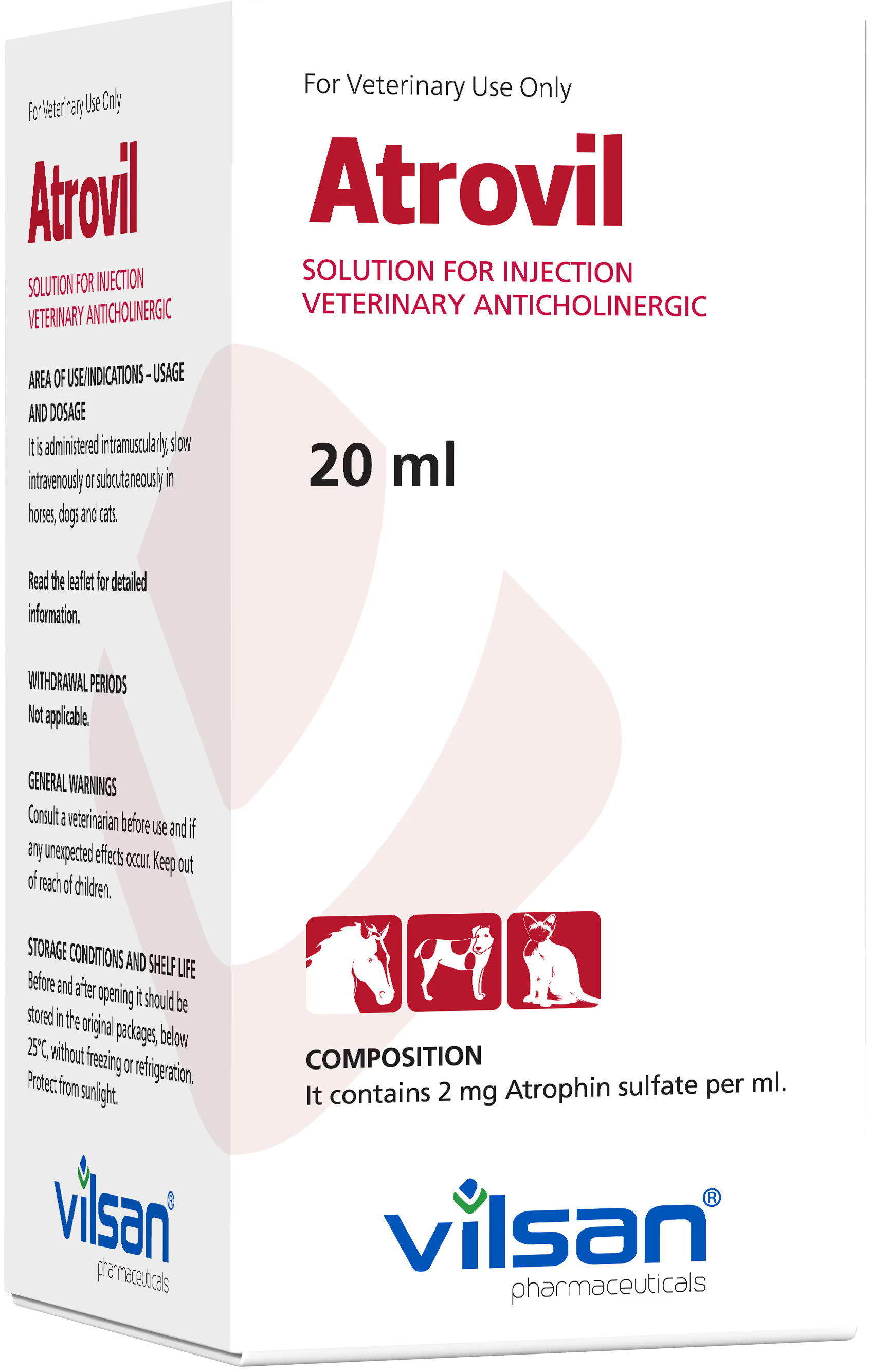
| Product Group | : | Clinical Products |
| Pharmaceutical Form | : | Solution for Injection |
| Active Ingredient | : | Atropine sulfate |
| Target Animal | : | Horse, Dog, Cat |
| Package Form | : | 20 ml Amber Colored Glass Flacons |
COMPOSITION
Atrovil is a colorless or light yellow colored clear solution containing 2 mg Atrophin sulfate and 10 mg Benzyl alcohol as a preservative per ml.
PHARMACOLOGICAL PROPERTIES
Atropine is a tertiary amine alkaloid with peripheral and central antimuscarinic effects. It first stimulates and then depresses the central nervous system and has an antispasmodic effect on smooth muscles. It causes peripheral vasodilation with an increase in blood pressure and a mild respiratory stimulatory effect. It inhibits the vagus nerve, thereby increasing heart rate, reducing bronchial secretion and salivation, and is used as premedication in anesthesia by reducing vagal inhibition.
It also suppresses gastric acid and pancreatic secretion. Its competitive antagonistic effect on acetylcholine in organs is dose-dependent. Salivary and sweat glands are sensitive to low doses of atropine. The vagolytic effect on the heart occurs at high doses. The digestive and urinary systems are least sensitive to atropine.
It is also used in the management or treatment of bradycardia and asystole. Atropine and other antimuscarinic drugs prevent the muscarinic side effects of anticholinesterases, which reverse the non-depolarizing effects of neuromuscular blocking agents.
Atropine reduces tremor and muscle rigidity, as seen in Parkinson's disease. It also has cycloplegic and mydriatic properties. It is used as a partial antidote in cases of organophosphate poisoning.
It is rapidly absorbed after administration. It distributes throughout the body. Its half-life is 2.5 hours. It is excreted in urine, partially unchanged, and also in breast milk.
AREA OF USE/INDICATIONS
Atrovil Solution for Injection is used in horses, dogs, and cats.
It is used as a partial antidote in anticholinesterase poisoning (phosphoric esters, carbamates, organochlorines, etc.)
Pre-anesthetic to prevent bradycardia and bronchial secretion during general anesthesia,
Spasmolytic in smooth muscles (such as the digestive system, urinary system, uterus, bronchi, and bile duct),
Cardiac stimulant in cases of atrioventricular block or sinus bradycardia,
Bronchial secretion reducer and respiratory stimulant.
USAGE AND DOSAGE
Depending on the physician's choice, it is generally administered at a dose of 25-500 μg/kg body weight. Lower doses are used more for parasympatholytic effects and preanesthetic purposes, while higher doses are used in anticholinesterase-effective poisonings. In cases of atrioventricular block or sinus bradycardia, it can be administered every 6-8 hours until improvement is achieved.
In anticholinesterase poisoning, it is used as follows:
Severe cases: A portion (one-quarter) of the required dose is administered intramuscularly or slow intravenously; the remaining part is administered subcutaneously.
Less severe cases: The entire dose is administered subcutaneously.
Repeated doses may be required depending on the severity of the poisoning. The administration interval is generally 3-4 hours, but it depends on the recurrence interval of severe or moderate symptoms.
Atropine takes effect within minutes of administration, and the maximum effect may be delayed for up to 5-10 minutes after administration.
SPECIAL CLINICAL INFORMATION AND SPECIAL WARNINGS FOR TARGET SPECIES
It should be noted that hyperthermia may occur in situations where the ambient temperature is high.
Animals treated with atropine should be kept under clinical observation.
Use during pregnancy: Studies conducted on animals have shown that it is not teratogenic and has no effect on the reproductive system. However, as atropine can cross the placenta and blood-milk barrier, its use is not recommended in pregnant or lactating animals.
ADVERSE EFFECTS
The effects of atropine are dose-dependent. While the glands are sensitive to low doses, higher doses are required for the vagolytic effect on the heart muscle. The anticholinergic effect may persist during the emergence from anesthesia. Effects such as dry mouth, mydriasis, constipation, accommodation disorder, tachycardia, vomiting, abdominal distension, and urinary retention may develop.
DRUG INTERACTIONS
Atropine sulfate can be used in combination with inhalation anesthetics, barbiturates, xylazine, ketamine, and acepromazine. There is literature indicating that the use of anticholinergics such as atropine in combination with alpha-2 receptor agonists such as medetomidine or xylazine in dogs for sedation or premedication purposes may cause tachycardia and persistent hypertension. Atropine sulfate antagonizes the effects of metoclopramide. Quinidine, disopyramide, glutethimide, meperidine, procaine, and procainamide increase the antimuscarinic effect of atropine. Anticholinergic drugs such as amantadine, some antihistamines, butyrophenones, and phenothiazines increase the anticholinergic effect of atropine. Atropine increases the toxic effect of ranitidine.
Asepromazine maleate, chlorpromazine HCl, sodium heparin, alkalis, tannic acid, and silver salts should not be used in combination.
SYMPTOMS OF OVERDOSE, PRECAUTIONS AND ANTIDOTE
Symptoms of overdose consist of a combination of central and peripheral effects of atropinization. Early symptoms are characterized by stimulation. Dry mouth, dysphagia, mydriasis, tachycardia, constipation, hyperpnea, muscle tremors, and ataxia may be observed. At high doses, agitation is followed by depression, cardiovascular collapse, respiratory arrest, paralysis, and coma. Anticholinesterase drugs such as physostigmine can be used as an antidote at a dose of 0.1-0.6 mg/kg intravenously.
Agitation can be alleviated with appropriate sedatives. Peripheral effects can be reduced with physiological antidotes such as pilocarpine. In cases of overdose or advanced stages of atropine poisoning, medullary stimulants or artificial respiration may be required.
WITHDRAWAL PERIODS
Not applicable.
CONTRAINDICATIONS
Not to be used in animals that are sensitive to atropine, have intestinal obstruction, or are likely to have jaundice. Not to be used in cases of glaucoma, paralytic ileus, or pyloric stenosis. Not to be used in patients with heart failure, hyperthyroidism, hyperthermia, or arrhythmia.
GENERAL WARNINGS
Consult a veterinarian before use and if any unexpected effects occur. Keep out of reach of children.
PRECAUTIONS TO BE TAKEN BY THE ADMINISTRATOR AND WARNINGS FOR VETERINARY SURGEON
Necessary precautions should be taken to avoid accidental self-injection. In case of injection, medical treatment should be sought immediately and the package insert and label should be shown to the doctor. Wash your hands after use.
STORAGE CONDITIONS AND SHELF LIFE
Before and after opening it should be stored in the original packages, below 25°C, without freezing or refrigeration. Protect from sunlight. The shelf life is 2 years.
DISPOSAL AFTER USE AND WARNINGS FOR NON-TARGET SPECIES
Any unused or leftover product should be disposed of in accordance with applicable regulations.
COMMERCIAL PRESENTATION FORM
20 ml amber colored glass vials with cardboard boxes.
PLACE AND CONDITIONS OF SALE
It is sold in pharmacies and veterinary clinics with a veterinary prescription (VSP).
APPROVAL DATE OF LEAFLET: 20.12.2022
MARKETING AUTHORIZATION DATE AND NO: 23.11.2001 – 010/0985
MARKETING AUTHORIZATION HOLDER
VİLSAN Veteriner İlaçları Tic. ve San. A.Ş.
Balıkhisar Mah. Balıkhisar Köy İçi Küme Evleri No:765A Akyurt/Ankara-Türkiye
MANUFACTURER COMPANY
VİLSAN Veteriner İlaçları Tic. ve San. A.Ş.
Balıkhisar Mah. Balıkhisar Köy İçi Küme Evleri No:765A Akyurt/Ankara-Türkiye
Made in Turkiye