| - | - | - |
|---|---|---|
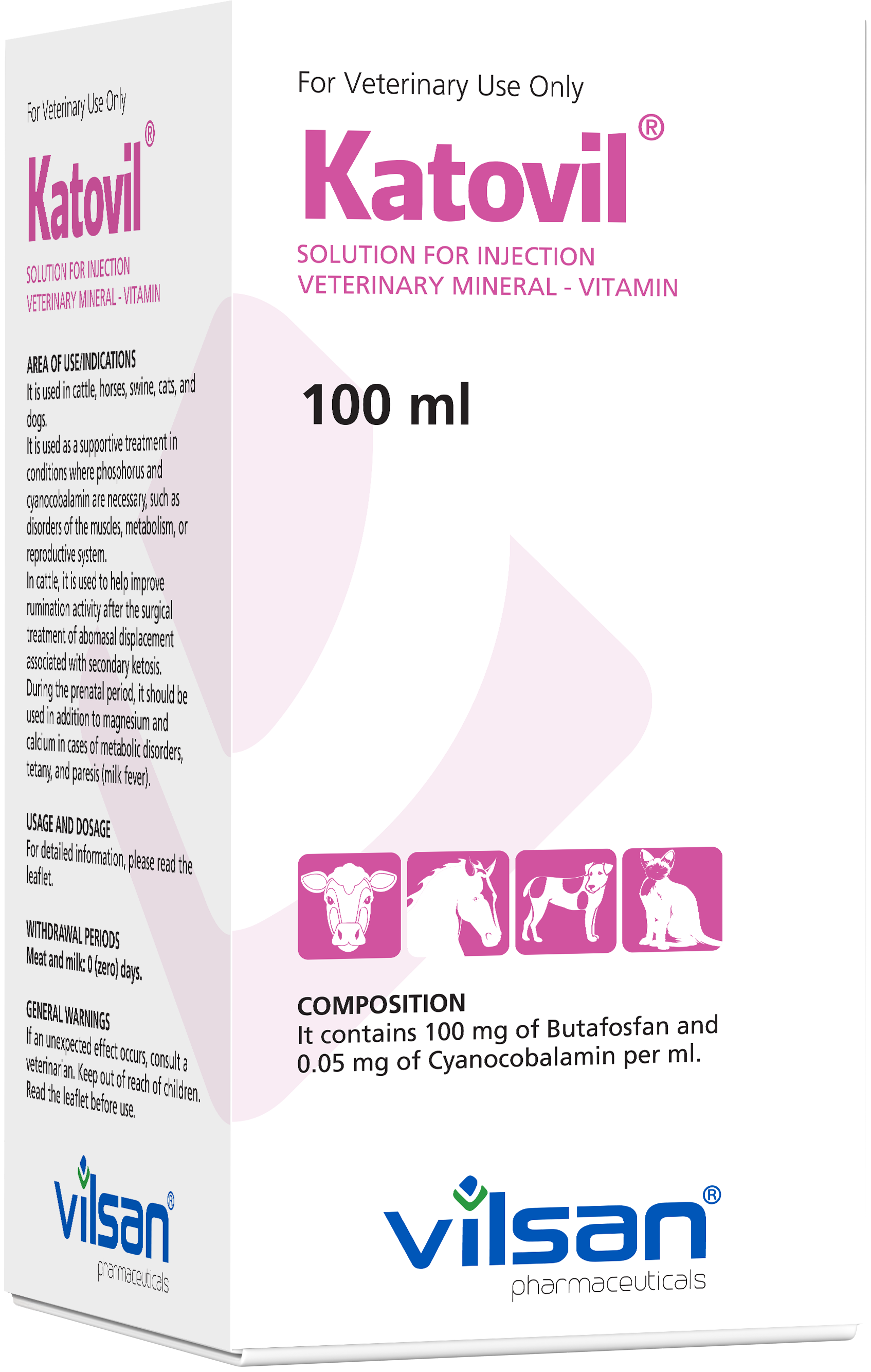
| Product Group | : | Vitamins and Minerals |
| Pharmaceutical Form | : | Solution for Injection |
| Active Ingredient | : | Butafosfan, Cyanocobalamin |
| Target Animal | : | Cattle, Horse, Dog, Cat |
| Package Form | : | 50 ml, 100 ml amber glass vials |
COMPOSITION
Katovil is a clear, reddish-colored solution that contains 100 mg Butafosfan and 0.05 mg Cyanocobalamin per ml.
PHARMACOLOGICAL PROPERTIES
Pharmacodynamic properties
Butafosfan is an organic phosphorus source for metabolism. Phosphorus is important for energy metabolism, among other functions, and has a stimulating effect. It is also a component of bone tissue. Due to its use in the phosphorylation of most intermediates, it is an essential element for the process of neoglucogenesis.
Cyanocobalamin is a coenzyme used in the synthesis of glucose from propionate. It also serves as a cofactor for enzymes important in the synthesis of fatty acids and plays a key role in the maintenance of normal hematopoiesis, liver protection, and the health of muscle tissue, skin, brain, and metabolism. It is also involved in the formation of red blood cells and the synthesis of methionine. It is a water-soluble B-group vitamin synthesized by the digestive system flora (reticulo-rumen and large intestine) in animals. Due to the specific needs of the flora, synthesis is typically not sufficient to meet the overall needs of the animal organism. Significant deficiencies are rare, even in cases where cyanocobalamin intake is inadequate.
Pharmacokinetics Properties
Butafosfan, after a single intravenous dose in cattle, is distributed to the extravascular space within minutes and is rapidly excreted unchanged from the body. Its elimination half-life is 83 minutes. Twelve hours after intravenous administration, 70-90% of the dose is excreted in the urine, and 1% is excreted in the feces. Only traces of butafosfan are found in milk. No metabolic changes have been detected.
The metabolism of Cyanocobalamin is complex and closely related to folic acid and ascorbic acid. Vitamin B12 is stored in significant amounts in the liver, with other storage sites including the kidneys, heart, spleen, and brain. The tissue half-life of Vitamin B12 is 32 days. In ruminants, Vitamin B12 is primarily excreted in the feces and in smaller amounts in the urine.
AREA OF USE/INDICATIONS
It is used in cattle, horses, swine, cats, and dogs.
It is used as a supportive treatment in conditions where phosphorus and cyanocobalamin are necessary, such as disorders of the muscles, metabolism, or reproductive system.
In cattle, it is used to aid the recovery of rumination activity following the surgical treatment of abomasal displacement associated with secondary ketosis.
During the prenatal period, it should be used in addition to magnesium and calcium in cases of metabolic disorders, tetany, and paresis (milk fever).
USAGE AND DOSAGE
The doses provided below are recommended doses. The dose and administration intervals may vary depending on the condition and needs of the animals, and are subject to the veterinarian's decision.
Cattle, Swine:
Administered intravenously.
For the treatment of phosphorus and/or Vitamin B12 deficiency:
In adult cattle, 2-5 mg of butafosfan and 0.001-0.0025 mg of cyanocobalamin per kg body weight are administered (practically, 2-5 ml per 100 kg body weight).
In calves, 10-25 mg of butafosfan and 0.005-0.0125 mg of cyanocobalamin per kg body weight are administered (practically, 10-25 ml per 100 kg body weight).
In necessary cases, injections are repeated daily.
After the surgical treatment of abomasal displacement associated with secondary ketosis, to aid the recovery of rumination activity:
5 ml per 100 kg body weight, one injection per day for three days. The first injection should be given on the day of the operation.
Horses:
Administered intravenously.
In adult horses, 2-5 mg of butafosfan and 0.001-0.0025 mg of cyanocobalamin per kg body weight are administered (practically, 2-5 ml per 100 kg body weight).
In foals, practically 0.35-0.6 ml is administered per 10 kg body weight.
Cats and Dogs:
Administered intravenously, intramuscularly, or subcutaneously.
In dogs, 2.5-25 mg of butafosfan and 1.0-2.5 mg of cyanocobalamin per kg body weight are administered (practically, 0.25-2.5 ml per 10 kg body weight).
In cats, 10-50 mg of butafosfan and 5-25 mg of cyanocobalamin per kg body weight are administered (practically, 0.5-5 ml per 5 kg body weight).
In chronic conditions, half of the prescribed dose is given initially, and the remaining half is administered 1-2 weeks later.