| - | - | - |
|---|---|---|
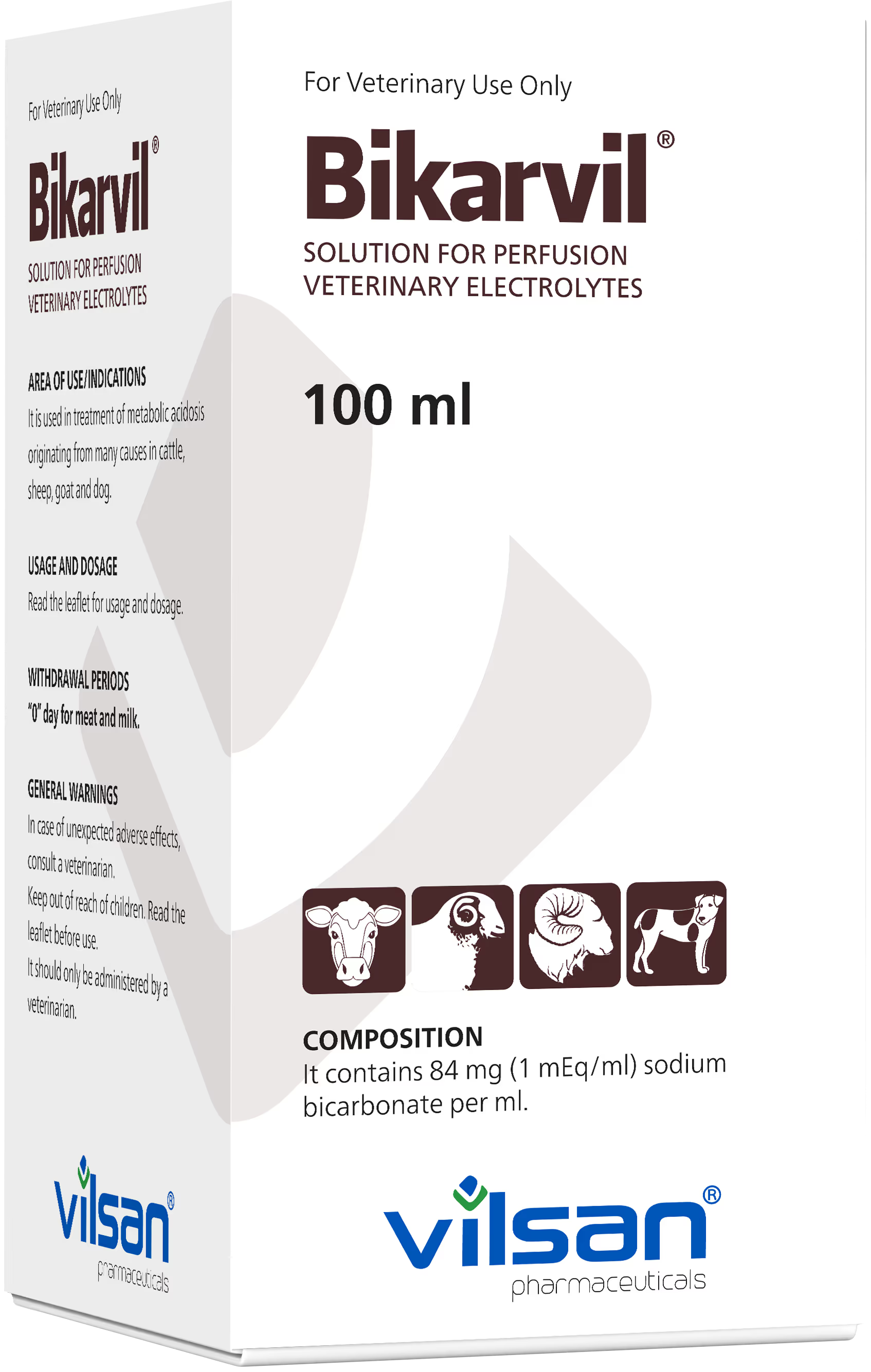
| Product Group | : | Perfusion Solutions |
| Pharmaceutical Form | : | Solution for Perfusion |
| Active Ingredient | : | Sodium bicarbonate |
| Target Animal | : | Cattle, Horse, Sheep, Goat, Dog |
| Package Form | : | 100 ml and 250 ml Amber Colored Glass Flacons |
COMPOSITION
It is a colorless, clear, ready-to-use solution containing 84 mg (1 mEq/ml) sodium bicarbonate per ml.
PHARMACOLOGICAL PROPERTIES
Pharmacodynamic properties
Sodium bicarbonate is an alkalizing agent that has a rapid effect on the acid-base balance of plasma. The bicarbonate-carbonic acid system is the body's main system for physiological regulation. Carbonic acid is the main acid end product of metabolism. Unlike other proton donors, H2CO3 is converted into a volatile form (CO2) that is exhaled from the lungs. Unlike macromolecular buffer systems, HCO3- and H2CO3 can be excreted by the kidneys, and their concentrations in urine can be physiologically regulated.
The ratio of the bicarbonate-carbonic acid system at pH = 7.4 is 20:1.
The lungs play a major role in the daily excretion of acid. Approximately 10 millimoles of CO2 are produced per minute and exhaled. The CNS (Central Nervous System) mechanisms responsible for the frequency and depth of respiratory activity respond to pCO2 and pH. Ventilation changes increase in response to a decrease in pH or an increase in pCO2, which is used to remove more acid, such as CO2. Changes in ventilation in response to acid-base abnormalities are usually very rapid.
As a systemic alkalizing agent, sodium bicarbonate acts by increasing plasma bicarbonate to buffer the excess concentration of hydrogen ions and raise blood pH, thereby reversing the clinical symptoms of acidosis.
As a urinary alkalinizer, sodium bicarbonate increases urinary pH by enhancing the excretion of free bicarbonate ions in urine. By maintaining alkalinity in urine, it can facilitate the dissolution of uric acid stones, one of the primary goals of urinary alkalization.
Pharmacokinetic properties
Intravenous sodium bicarbonate infusion exhibits rapid distribution. The components of the infusion solution are metabolized and excreted via the same pathways as substances obtained from traditional food sources.
AREA OF USE/INDICATIONS
It is used as a supportive treatment in the management of metabolic acidosis in cattle, horses, sheep, goats, and dogs (particularly in respiratory acidosis caused by carbon dioxide retention; in metabolic acidosis caused by the accumulation of acidic metabolites associated with metabolic disorders; and in renal acidosis associated with inadequate excretion of hydrogen ions by the kidneys). It is used for alkalinization purposes for rehydration in cases of mild diarrhea.
USAGE AND DOSAGE
It should be administered slow intravenously.
The volume of product to be infused per animal is preferably calculated based on biochemical analysis of the deficiency, and if this is not possible, clinical signs are accepted as an indicator of the deficiency.
In severe acidosis, the bicarbonate level in animals drops to 10-15 mEq/L. Bicarbonate, an important anion of extracellular fluid, ranges from 17-35 mEq/L depending on the animal species; this value averages around 30 mEq/L in cattle. In a cow in this condition, considering the above bicarbonate value, there is a deficit of 10-15 mEq/L.
The extracellular fluid ratio is considered to be 20% of body weight. Accordingly, based on body weight, the bicarbonate requirements of some animals (e.g., when it is 10 mEq/L) are calculated as follows:
500 kg body weight for cattle:
500 x 10 mEq/L x 0,2 = 1000 mEq (500 ml product)
50 kg body weight for sheep
50 x 10 mEq/L x 0,2 = 100 mEq (50 ml product)
10 kg body weight for dog:
10 x 10 mEq/L x 0,2 = 20 mEq (10 ml product)
The concentration of the solution is determined according to the patient's condition and requirements and can be used undiluted (8.4%) or isotonic (1.5%). The amount of sodium bicarbonate to be administered over a 4-8 hour period is adjusted according to the severity of acidosis, total carbon dioxide content, blood pH, and the animal's clinical condition, and is administered at approximately 2-5 mEq/kg (or 1-2.5 ml/kg) body weight. If the plasma carbon dioxide level is unknown, an average dose of 2 ml/kg body weight of BIKARVIL can be administered in 5% dextrose, isotonic saline, or an appropriate solution. Treatment is continued at an isotonic (1.5%) dilution rate. Completion of treatment depends on the animal's clinical condition. If severe symptoms subside, the frequency and amount of the dose should be reduced.
Before administration, the solution should be gently warmed to 37°C.
SPECIAL CLINICAL INFORMATION AND SPECIAL WARNINGS FOR TARGET SPECIES
It should only be used in animals under veterinary supervision.
Aseptic technique must be observed during administration. It should only be used if the solution is clear, free from visible particles, and the vial is undamaged. As this veterinary medicinal product does not contain an antimicrobial preservative, it is for single use only and any unused contents should be discarded.
As this veterinary medicinal product is a hypertonic sodium bicarbonate solution, it must be administered with caution; it should be administered slow intravenously and at body temperature. Rapid injection of sodium bicarbonate solutions is dangerous and can cause death by disrupting intra- and extracellular ion concentrations. An undesirable increase in plasma sodium concentration may occur during correction of metabolic acidosis. Sodium bicarbonate therapy should be administered with caution as the patient's response cannot be predicted.
Before administering sodium bicarbonate, arterial pH, plasma carbon dioxide content, and base deficit calculations should be performed. Additionally, periodic monitoring during parenteral administration is recommended to prevent overdose and the development of alkalosis.
Sodium bicarbonate acts as a peripheral vasodilator and may cause hypotension in anesthetized patients; therefore, adequate ventilation must be ensured.
Hypertonic solutions should not be administered by any route other than intravenously. Avoid rapid administration due to the risk of alkalosis.
In general, sodium bicarbonate is not recommended for patients with metabolic or respiratory alkalosis, hypochlorhydria, or hypocalcemia. Sodium bicarbonate should be administered with extreme caution and infused very slowly to patients with congestive heart failure, renal impairment, hypokalemia, liver cirrhosis, or arterial hypertension, and to patients receiving corticosteroid therapy. It should be used with caution in patients with oliguria and anuria.
Alkalization of urine by sodium bicarbonate increases the renal clearance of acidic drugs. When used to eliminate drugs such as salicylates or barbiturates, high urine output should be maintained.
Use during pregnancy: It can be used during pregnancy and lactation.
ADVERSE EFFECTS
Muscle pain, loss of appetite, nausea, or vomiting may occur. An undesirable increase in plasma sodium concentration may occur during correction of metabolic acidosis.
Rapid injection of sodium bicarbonate solutions is dangerous and may lead to metabolic complications such as tetany due to hypocalcemia, tissue anoxia, paradoxical acidosis of the central nervous system, and hypokalemia due to the shift of K+ from the interstitium to the cells, which may cause death by disrupting intracellular and extracellular ion concentrations.
DRUG INTERACTIONS
Sodium bicarbonate should not be mixed with solutions containing calcium or magnesium, as this may cause precipitation or cloudiness; sodium lactate intravenous infusion, epinephrine, norepinephrine tartrate, pethidine hydrochloride, Ringer's solution, streptomycin sulfate, vitamins B and C, glucocorticoid corticosteroids, mineralocorticoid corticosteroids and corticopropropyl, amphetamines and quinidine, androgens and anabolic steroids, oral anticoagulants such as coumarin or indandione derivatives, antidyskinesics, antimuscarinics, benzodiazepines such as chlordiazepoxide and diazepam, cimetidine or ranitidine, diflunisal, potassium-sparing diuretics, ephedrine, oral iron supplements and preparations, ketoconazole, levodopa, lithium, oral loxapine, mecamylamine, mexiletine, potassium supplements, salicylates, sucralfate, oral tetracyclines, and oral thioxanthene derivatives.
This veterinary medicinal product should not be mixed with other veterinary medicinal products.
SYMPTOMS OF OVERDOSE, PRECAUTIONS AND ANTIDOTE
Avoid exceeding the recommended dose due to the risk of extracellular fluid hyperosmolarity, intracranial hemorrhage, and metabolic alkalosis (muscle spasms in superficial muscles, arrhythmia in the heart muscle, general depression, and coma symptoms). In such cases, sodium bicarbonate injection should be discontinued and treatment should be administered according to the degree of alkalosis. For this purpose, 0.9% sodium chloride administered intravenously can be used to adjust the plasma chloride ion level. Potassium chloride can be administered if hypokalemia is present. In cases of severe alkalosis, hypersensitivity or tetany may be observed. Calcium gluconate can be used to control tetany. Additionally, a 1/6 molar ammonium chloride solution can be administered intravenously as an acidifying agent. High doses may cause pulmonary edema.
WITHDRAWAL PERIODS
‘0’ day for meat and milk.
CONTRAINDICATIONS
It should not be used in animals with sodium-retaining oedematous conditions such as metabolic or respiratory alkalosis, convulsions, congestive heart failure, and liver cirrhosis.
It should not be used in animals with chloride loss due to vomiting and in animals treated with diuretics known to cause hypochloremic alkalosis, as it may pose a risk of severe alkalosis.
GENERAL WARNINGS
It should be administered only by the veterinarian. Consult a veterinarian if any unexpected effects occur. Keep out of reach of children.
PRECAUTIONS TO BE TAKEN BY THE ADMINISTRATOR AND WARNINGS FOR VETERINARY SURGEON
Avoid contact with the product and wash your hands after use.
STORAGE CONDITIONS AND SHELF LIFE
It should be stored in the original packages, below 25°C, without freezing or refrigeration. Protect from sunlight. Turbid or sediment containing solutions should not be used. The shelf life is 3 years. Opened vials should not be used and any unused portion should be destroyed.
DISPOSAL AFTER USE AND WARNINGS FOR NON-TARGET SPECIES
Any unused or leftover product should be disposed of in accordance with applicable regulations.
COMMERCIAL PRESENTATION FORM
100 ml and 250 ml amber colored glass vials with butyl stopper in cardboard boxes.
PLACE AND CONDITIONS OF SALE
It is sold in pharmacies, veterinary surgeries, polyclinics and animal hospitals with a veterinarian's prescription (VHR).
APPROVAL DATE OF LEAFLET: 10.08.2021
MARKETING AUTHORIZATION DATE AND NO: 13.03.2001 – 010/0930
NAME AND ADDRESS OF MARKETING AUTHORIZATION HOLDER
VILSAN Veteriner İlaçları Tic. Ve San. A.Ş.
Balıkhisar Mah, Balıkhisar Köyiçi Küme Evleri No: 765A, Akyurt/Ankara – Türkiye
MANUFACTURER COMPANY
VILSAN Veteriner İlaçları Tic. Ve San. A.Ş.
Balıkhisar Mah, Balıkhisar Köyiçi Küme Evleri No: 765A, Akyurt/Ankara – Türkiye
Made in Turkiye