| - | - | - |
|---|---|---|
| Product Group | : | Udder Health |
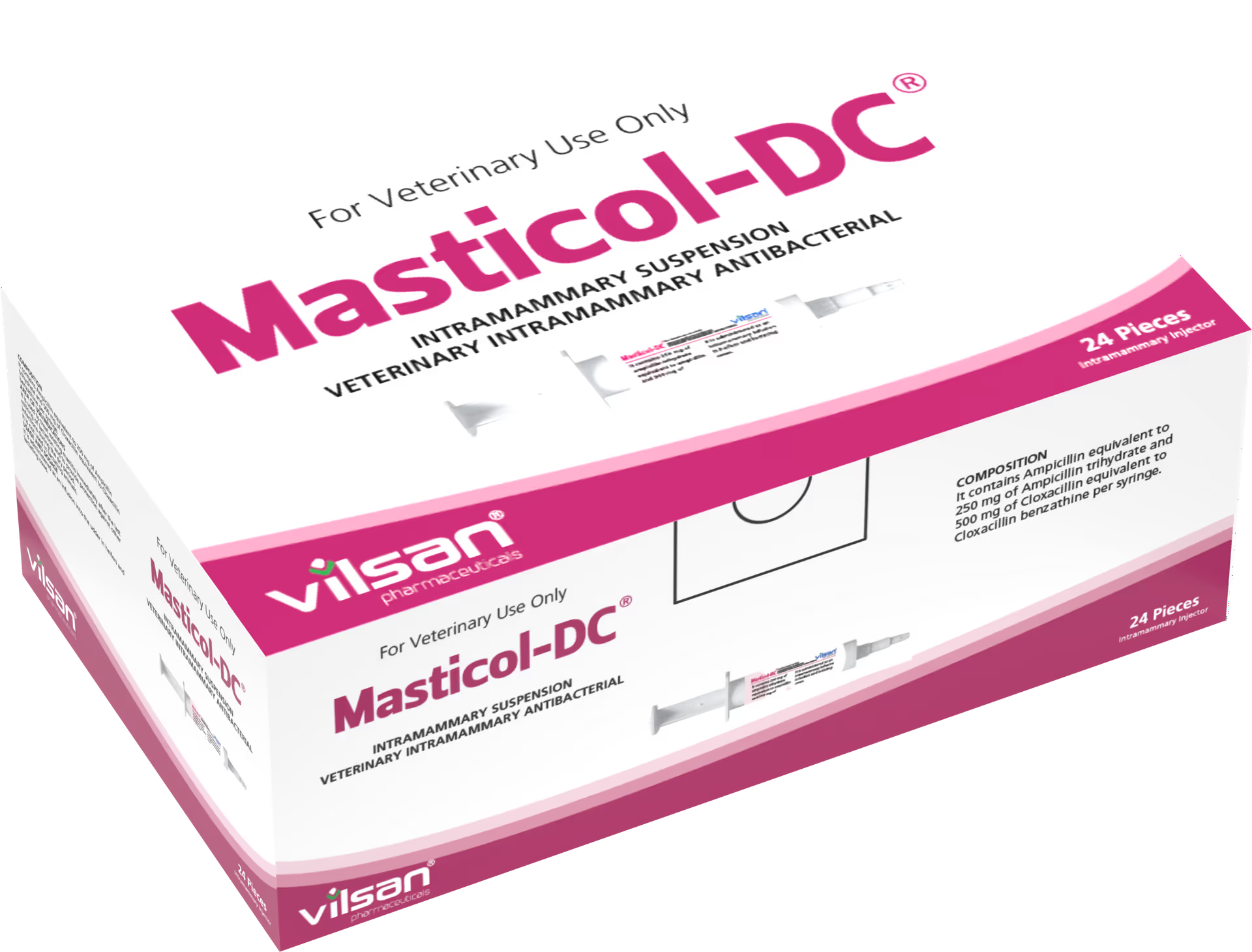
| Pharmaceutical Form | : | Intramammary Suspension |
| Active Ingredient | : | Ampicillin trihydrate, Cloxacillin benzathine |
| Target Animal | : | Cow (dry period) |
| Package Form | : | 5 ml plastic syringes (box of 24) |
COMPOSITION
It is a ready-to-use, sterile suspension with a creamy color containing ampicillin trihydrate equivalent to 250 mg of ampicillin and cloxacillin benzathine equivalent to 500 mg of cloxacillin per syringe.
PHARMACOLOGICAL PROPERTIES
Pharmacodynamic Properties
Both active substances belong to the beta-lactam class of antibiotics. Their structures contain the same beta-lactam and thiazolidine rings.
Beta-lactam antibiotics exert their effect during the final stage of peptidoglycan synthesis, thereby preventing the proper formation of the bacterial cell wall. They inhibit the activity of transpeptidase enzymes, which catalyze the cross-linking of glycopeptide polymer units that make up the cell wall.
They exhibit a bactericidal effect, but only cause lysis in actively growing bacteria.
The difference in susceptibility between Gram-positive and Gram-negative bacteria is attributed to variations in receptor sites, the relative amount of peptidoglycan present, the ability of the drug to penetrate the outer membrane of Gram-negative bacteria, and differences in the types of beta-lactamase enzymes produced by the bacteria.
Ampicillin has high activity against both Gram-positive and Gram-negative bacteria but is inactivated by beta-lactamases.
Cloxacillin is relatively resistant to staphylococcal beta-lactamases, but has lower activity than penicillin G against susceptible Gram-positive bacteria and is inactive against Gram-negative bacteria.
The combination of penicillinase-resistant penicillins, such as ampicillin with cloxacillin, has shown synergistic effects in many cases against common opportunistic Gram-negative bacteria.
Pharmacologial Properties
On a long-acting base, cloxacillin benzathine and ampicillin trihydrate maintain effective antibacterial concentrations in the dry cow udder for up to 10 weeks without causing irritation to the mammary tissue.
AREA OF USE/INDICATIONS
It is administered immediately after the final milking of lactation to treat existing mastitis and to provide protection against new infections during the dry period.
It is active against Gram-positive and Gram-negative organisms associated with mastitis, including Streptococcus agalactiae and other Streptococcus species, penicillin-resistant and susceptible Staphylococci, Arcanobacterium spp., Escherichia coli, and other susceptible Gram-negative bacteria.
USAGE AND DOSAGE
It is administered via intramammary infusion in heifers and lactating cows.
Following the final milking, one tube should be infused into each quarter after thoroughly cleaning and disinfecting the teat end.
Please also refer to the section "Special Clinical Information and Special Warnings for Target Species" for important precautions.
SPECIAL CLINICAL INFORMATION AND SPECIAL WARNINGS FOR TARGET SPECIES
During administration, the syringe tip should not be inserted into the teat canal. The following method of administration is recommended:
The animal should be properly restrained. The teat ends are cleaned and disinfected. The tip of the syringe is positioned at the teat orifice but not inserted into the teat canal. When the plunger is pressed, the product flows from the teat tip into the mammary tissue.
This product should be used whenever possible based on susceptibility testing of bacteria isolated from infected animals. If this is not feasible, treatment should be based on regional epidemiological information.
Feeding calves with milk containing ampicillin and cloxacillin residues may result in the development of resistant intestinal bacteria in the calves. Therefore, it is not recommended to feed calves with milk from treated animals during the withdrawal period.
Use during pregnancy: This product may be used during pregnancy. Not for use during lactation.
ADVERSE EFFECTS
Very rarely, allergic reactions and irritation of the mammary tissue may occur.
For the reporting of adverse reaction frequency, the following classification is used:
· Very common (more than 1 in 10 animals)
· Common (more than 1 but less than 10 in 100 animals)
· Uncommon (more than 1 but less than 10 in 1,000 animals)
· Rare (more than 1 but less than 10 in 10,000 animals)
· Very rare (less than 1 in 10,000 animals)
DRUG INTERACTIONS
The concurrent administration of anti-inflammatory and antipyretic drugs—particularly phenylbutazone and salicylates—may delay the renal excretion of penicillins.
Bactericidal penicillins should not be combined with bacteriostatic agents (e.g., tetracyclines, sulfonamides) due to potential antagonistic interactions.
This product should not be mixed with other veterinary medicinal products.
SYMPTOMS OF OVERDOSE, PRECAUTIONS AND ANTIDOTE
The recommended dose should not be exceeded.
WITHDRAWAL PERIODS
This product should not be used in cows with a short dry period.
It should not be used within 49 days prior to calving.
Milk obtained from treated cows should not be used for human consumption for up to 156 hours after calving.
If calving occurs before 49 days have passed since application, milk obtained during the 49 days + 156 hours period following treatment should not be used for human consumption. In such cases, please consult your veterinarian.
In cows that develop hypocalcemia, a longer withdrawal period than the one specified above is required. In this case, milk should not be used for human consumption until the cloxacillin level drops below 0.03 mcg/ml and the ampicillin level falls below 0.004 mcg/ml.
Cows should not be sent for slaughter within 28 days of treatment.
This product is not for use in lactating animals. In case of accidental use during lactation, milk obtained within 28 days should not be used for human consumption. Further tests should be performed to ensure that milk residue levels fall below the limits specified above before milk can be safely used for human consumption.
CONTRAINDICATIONS
This product should not be used in animals known to be sensitive to any of its components.
Not for use in lactating animals.
GENERAL WARNINGS
Consult a veterinarian before use and in case of any unexpected effects.
Keep out of reach of children and away from foodstuffs.
Do not purchase or use products past their expiration date or with damaged packaging.
PRECAUTIONS TO BE TAKEN BY THE ADMINISTRATOR AND WARNINGS FOR VETERINARY SURGEON
Protective gloves should always be worn during infusion. Avoid skin contact with the product.
Penicillins and cephalosporins may cause hypersensitivity to penicillin or cephalosporins (allergy) after injection, inhalation, ingestion, or skin contact (or vice versa).
Allergic reactions to these substances can occasionally be severe.
Individuals who are sensitive to these substances or those advised not to work with such products should not administer this product.
All recommended precautions should be taken to avoid exposure to the product, and it should be used with great care.
If contact with the product occurs, wash the affected area thoroughly with plenty of water.
If symptoms, such as a skin rash, develop after exposure, medical advice should be sought. Swelling of the face, lips, or eyes, or difficulty breathing are more serious symptoms and require emergency medical treatment. In such cases, seek immediate medical attention and show the product label/leaflet to your doctor.
Wash your hands after use.
STORAGE CONDITIONS AND SHELF LIFE
Store in the original packaging, protected from light, at a temperature below 25°C, without placing in a refrigerator or freezer.
The shelf life is 24 months.
DISPOSAL AFTER USE AND WARNINGS FOR NON-TARGET SPECIES
Used product packaging, unused product, or any remaining product should be disposed of according to the relevant regulations.
COMMERCIAL PRESENTATION FORM
5 g plastic syringes in a carton box containing 24 units.
PLACE AND CONDITIONS OF SALE
It is sold in pharmacies and veterinary clinics with a veterinarian's prescription. (VHP)
APPROVAL DATE OF LEAFET: 09.01.2025
MARKETING AUTHORIZATION DATE AND NO: 17.07.1995 – 008/0730
NAME AND ADDRESS OF MARKETING AUTHORIZATION HOLDER
VİLSAN Veteriner İlaçları Tic. ve San. A.Ş.
Balıkhisar Mah. Balıkhisar Köy İçi Küme Evleri No:765A Akyurt/Ankara-Türkiye
MANUFACTURER COMPANY
VİLSAN Veteriner İlaçları Tic. ve San. A.Ş.
Balıkhisar Mah. Balıkhisar Köy İçi Küme Evleri No:765A Akyurt/Ankara-Türkiye
Made in Turkiye